Paper mills and large-scale logistics operations live or die by spare parts availability — a single bearing on a Fourdrinier wire section, a hydraulic seal on a conveyor drive, or a sortation belt motor can stop the entire line in minutes, and the cost of an emergency procurement run is 3–5× the cost of holding the part properly. The global maintenance, repair, and operations market reached $450.46 billion in 2026, yet most asset-heavy operations still discover 30–50% of their MRO parts have not moved in 24 months while simultaneously running emergency overnight shipments on the parts they actually need. The gap is not budget — it is visibility. Paper mills and warehouses that link inventory data to asset reliability cut working capital by 15–30% and eliminate the stockout-driven downtime that defines the industry. Start a free trial to connect your spare parts to your work order workflow — or book a demo to walk through your specific asset criticality matrix.
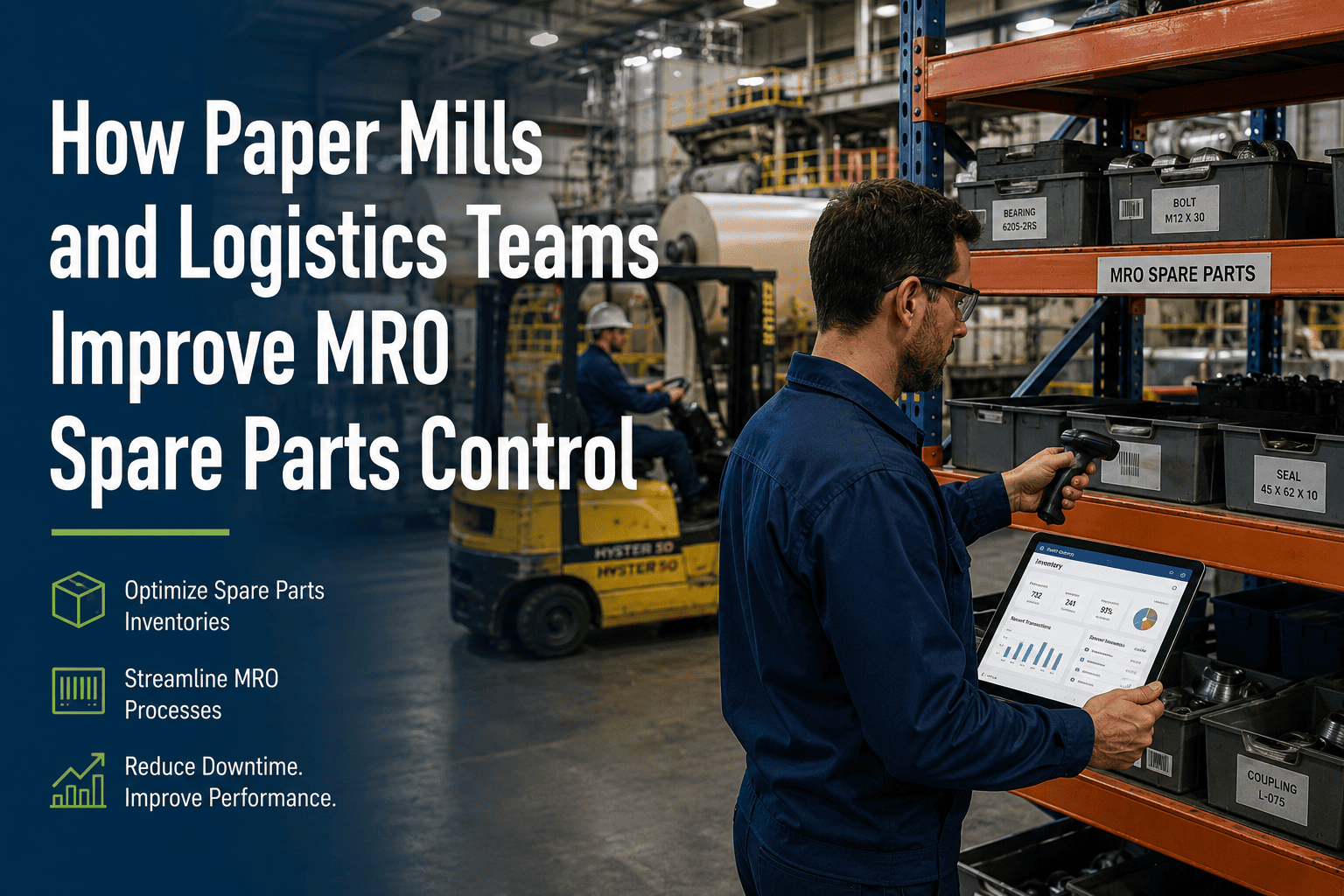
How Paper Mills and Logistics Teams Improve MRO Spare Parts Control
A practical framework for spare parts, inventory visibility, and repair readiness in asset-heavy operations. Connect bin locations, criticality scoring, and reorder points directly to work order workflow.
What is MRO Spare Parts Control
MRO spare parts control is the discipline of linking inventory data — every bin, every part, every reorder point — directly to asset reliability and work order workflow. Instead of purchasing buying parts based on vendor price and maintenance hoarding parts based on memory, every SKU has a documented criticality score, a defined min/max level tied to actual consumption, and a bin location every technician can find on a phone.
The model matters because asset-heavy operations carry a structural conflict: purchasing is rewarded for low carrying cost, maintenance is rewarded for zero stockouts, and the two metrics pull the inventory in opposite directions. The result is the pattern every plant manager recognises — $50,000 of obsolete motors gathering dust in row 12 while the $50 seal needed to fix the bottleneck machine today is on backorder. Unified MRO control closes this gap by making criticality, consumption, and asset reliability the shared decision criteria — start a free trial to see your own inventory profiled this way.
Six Concepts in Modern MRO Inventory Control
Six concepts separate plants and warehouses running disciplined MRO control from those running on purchasing habit and maintenance hoarding. Each represents a decision point that determines whether spare parts are an asset or a working-capital trap.
Pain Points in Paper Mill and Logistics MRO Inventory
Every plant manager and warehouse operations leader recognises the same six failure modes — and every one traces to the same root issue: inventory data lives in one system, maintenance work orders live in another, and reconciliation happens once a year during physical inventory if at all. Start a free trial to close this gap on your own SKU base.
How Oxmaint Solves MRO Inventory Control
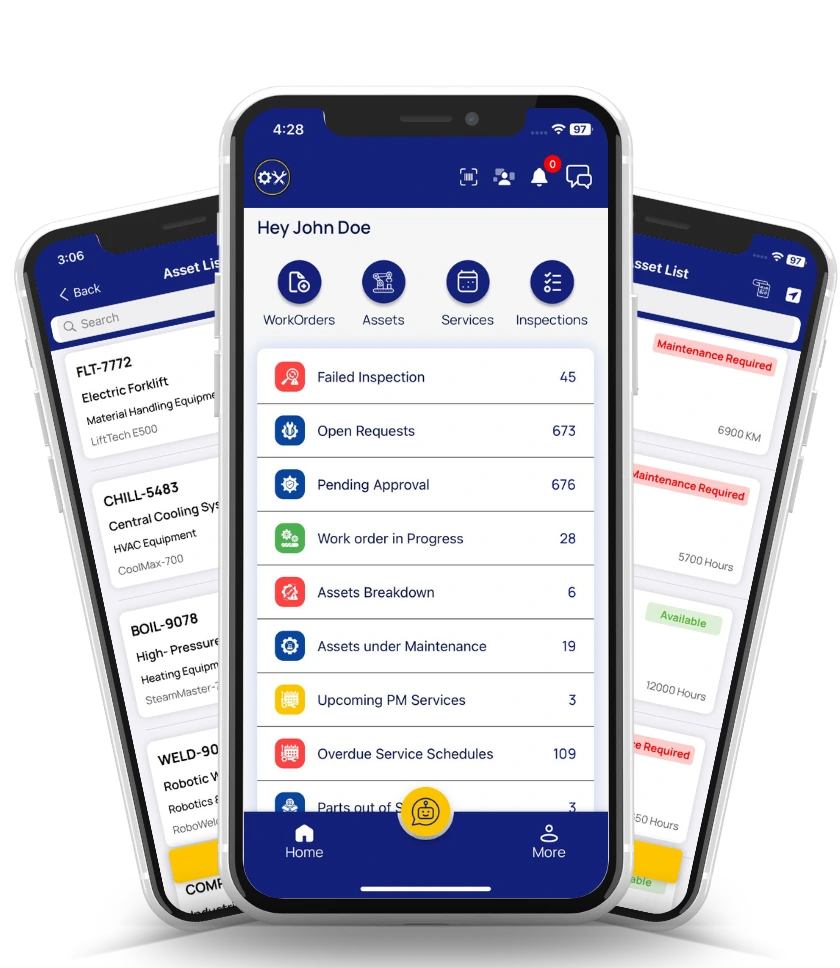
Oxmaint links spare parts to assets, work orders, and consumption data in one platform — so purchasing, maintenance, and warehouse operations work from the same truth. Implementation runs in days, not months — book a demo to walk through configuration on your own SKU base and criticality matrix.
Before vs After: Disconnected Inventory vs Linked MRO Control
The clearest argument for unified MRO control is the cost and downtime difference between disconnected inventory and linked maintenance workflow. The table below maps six common scenarios against both operating models — every row represents a real working-capital exposure or downtime event documented across paper mill and logistics operations. Start a free trial to validate the gap on your own SKU base.
| Scenario | Before (Disconnected Systems) | After (Linked MRO Control) |
|---|---|---|
| Critical Seal Stockout | Backorder, overnight shipping, 4-hour line stop, $14K downtime + 3–5× part cost | Consumption-based safety stock, part on shelf, 35-minute repair, zero unplanned downtime |
| Obsolete Motor Pile | $50K of motors for retired equipment, found at annual physical inventory, written off | No-movement alert at 18 months, surplus surfaced for transfer or sale, capital recovered |
| Technician Hoarding | System shows 6 bearings on hand, only 2 are findable, line waits while shop is searched | Issue-to-work-order tracking, locker check-out logged, physical reality matches the system |
| Reorder Point Drift | Min/max set in 2019, consumption doubled, stockouts every quarter, emergency PO each time | Reorder points recalculate quarterly from actual consumption, stockouts eliminated |
| Physical Inventory | Annual 3-day shutdown, 20–40% variance, write-offs that surprise finance | Rolling cycle counts, variance caught in days, no shutdown, audit-ready records |
| Capital Tie-Up | Working capital trapped in obsolete and slow-moving inventory, no visibility for finance | 15–30% working capital reduction, dashboard for CFO showing inventory turns by criticality |
ROI and Operational Outcomes from Unified MRO
The financial case for unified MRO control is documented across paper mill, logistics, and asset-heavy industrial operations. The numbers below represent the recurring annual returns measured at facilities that moved from disconnected inventory and maintenance systems to a linked platform — typically within the first 12 months. Most teams switching to structured CMMS-linked MRO see working capital drop 15–30% and emergency procurement spend cut in half — which is why a free trial costs nothing to validate against your own SKU base.
Frequently Asked Questions
Does Oxmaint integrate with our existing ERP or WMS
Can Oxmaint handle criticality scoring across thousands of SKUs
How does it handle physical inventory and cycle counts
Does it work for multi-site portfolios with shared inventory
Stop Losing Capital to Spare Parts You Cannot See
Turn every SKU into a tracked, scored, consumption-aware asset. Used by operations teams managing 10,000+ assets across paper, logistics, and heavy manufacturing.