Shift handovers are the most underestimated failure point in industrial maintenance. A mid-size manufacturing facility loses an average of $840,000 per year to incidents traced back to incomplete handover communication — missing fault notes, undocumented lockout transfers, half-finished work orders that the incoming crew never sees. Roughly 40% of plant incidents in heavy industry occur during or immediately after a shift change, and the cost of a single hour of unplanned downtime in automotive manufacturing now averages $260,000. The 2014 DuPont La Porte release that killed four workers was root-caused by the OSHA investigation to a chain of handover communication failures — written notes that never reached the next crew, verbal updates that omitted active maintenance bypasses. Automotive plants and breweries are the two industries that have built the strongest defences against this — and the lessons translate directly to every continuous-process operation. Start a free trial to digitise your handover process — or book a demo to see how Oxmaint replaces handover notebooks with a structured audit trail.
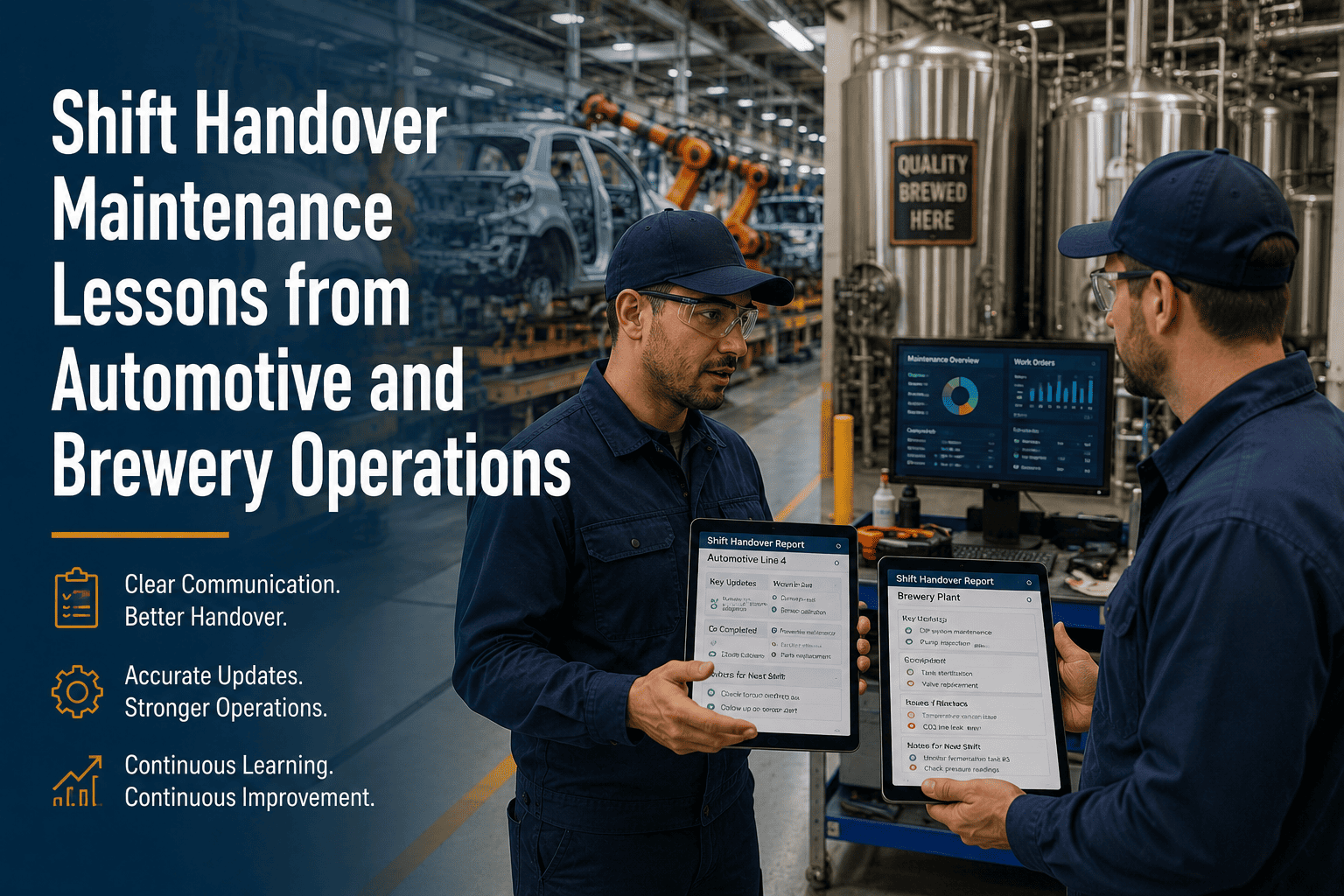
Shift Handover Maintenance Lessons from Automotive and Brewery Operations
Two industries that run 24/7 have engineered the cleanest shift-to-shift maintenance handovers in the world. Learn the patterns — SBAR briefings, structured closeout notes, LOTO transfer protocols — and how a CMMS turns them into an enforceable workflow.
What is Structured Shift Handover Maintenance
Structured shift handover maintenance is a formal protocol that transfers every open work order, active lockout, equipment condition note, and outstanding safety concern from the outgoing crew to the incoming crew through a documented, verifiable workflow. It replaces the historical model — a hurried verbal briefing, a notebook on the desk, a few scribbled comments — with a system where every transition is timestamped, signed by both parties, and stored as part of the asset's maintenance record.
The model matters because the cost of a single failed handover is asymmetric: most transitions cost nothing, but the rare miss can take out a production line for hours, trigger a recordable injury, or cost a brewery a full batch of beer. Automotive and brewery operations engineered the strongest defences because both run 24/7 continuous processes where the next crew inherits whatever state the previous crew left behind — clean or compromised. Teams that adopt structured handover see a 60–70% reduction in shift-transition incidents — start a free trial to digitise the protocol and remove the notebook from the equation.
Six Pillars of a Reliable Maintenance Handover
Six concepts separate plants that pass shift transitions cleanly from those that lose hours to confusion every changeover. Each one is a decision point — get them right and the next crew walks into a known state; get them wrong and downtime starts at the buzzer.
Where Handover Breaks Down — Six Failure Modes
The patterns that cause handover failures are remarkably consistent across automotive, brewery, food processing, and chemical operations. Six recurring failure modes account for the overwhelming share of shift-transition incidents and lost time — the same six show up in every after-action review. Most teams running paper or whiteboard handover sit at three or four of these simultaneously, often without realising it. Teams that fix even two of these typically recover 20–30% of lost productivity at shift boundaries — start a free trial to see the gaps in your own data.
How Oxmaint Builds Structured Handover Into the Workflow
Oxmaint turns the six pillars into enforceable steps that the system actually requires rather than relying on technician discipline. The shift cannot close until the structured fields are filled. The next shift cannot begin work on a flagged asset until they acknowledge the open notes. Every transition becomes a verifiable record — searchable by asset, by technician, by date — and the recurring-fault patterns surface automatically without anyone having to remember to look. Start a free trial to see how the protocol becomes part of the work order itself, not an external checklist.
Paper Notebook vs Digital Handover — Side by Side
The gap between traditional and structured handover is widest in the moments that matter most — when a fault is recurring, when a lockout is active, when the next crew is walking in cold. The comparison below is built from after-action reviews across automotive assembly, brewery operations, and food processing plants. The pattern is consistent across every site that has made the transition.
| Handover Dimension | Paper Notebook Handover | Digital Structured Handover |
|---|---|---|
| Briefing format | Free-text verbal or written | Mandatory SBAR fields with signatures |
| Lockout transfer | Verbal mention, sometimes missed | Digital acknowledgement required before work |
| Recurring fault tracking | Lost in shift-by-shift notes | Auto-flagged after 2nd occurrence |
| Audit retrieval | Days of binder search | Search by asset, technician, or date in seconds |
| Overlap enforcement | Optional, often skipped | System blocks shift close without briefing |
| Incident rate after change | High — 40% of incidents post-shift | Drops 60–70% within first quarter |
| Engineering visibility | Zero outside the shift | Real-time dashboard for reliability team |
ROI After Digital Handover Rollout
The numbers below come from automotive plants and breweries that completed a 12-month transition from paper to digital handover. The pattern is consistent — fewer shift-transition incidents, faster fault resolution, and a measurable drop in unplanned downtime — which is why operations teams managing 24/7 continuous processes are moving fastest on this category. The payback period is typically the first avoided incident.
Frequently Asked Questions
How does digital handover prevent incidents like the DuPont La Porte release
Will technicians actually use a digital handover process on the shop floor
Does Oxmaint integrate with our existing OEE and SCADA systems
How fast can a multi-shift plant roll this out
Stop Inheriting Yesterday's Problems at Every Shift Change
Turn every handover into a structured, signed, audit-ready transition — and let recurring faults surface before they become incidents.