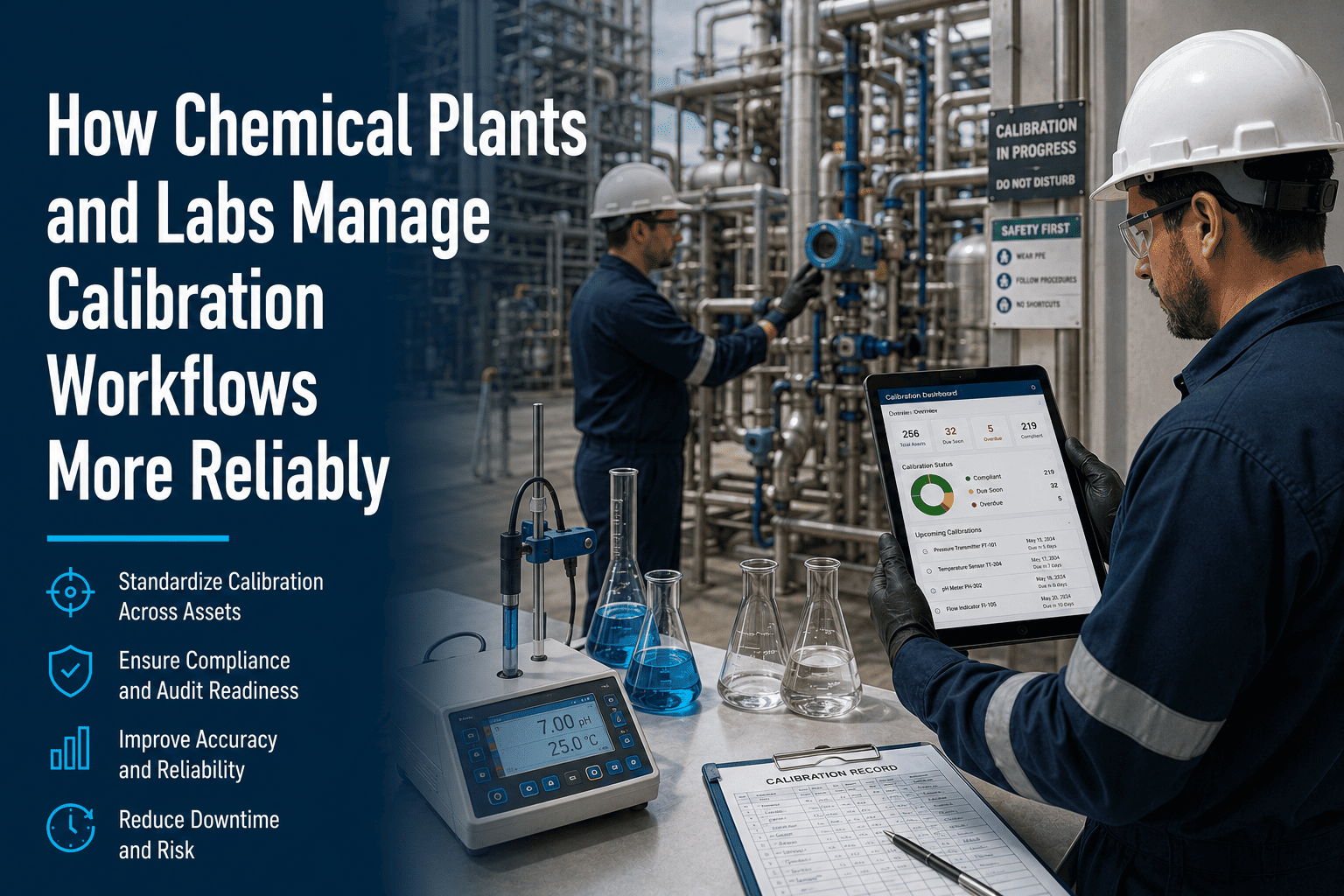
How Chemical Plants and Labs Manage Calibration Workflows More Reliably

Connect with Industry Experts, Share Solutions, and Grow Together!

Join Discussion Forum
chemical-plant-lab-equipment-calibration-workflows

Calibration is the function that decides whether a regulated facility passes or fails its next audit — and the function most likely to be running on a spreadsheet, a binder, and a senior technician's memory. A single undocumented or out-of-tolerance instrument in a chemical plant or pharmaceutical lab can trigger an FDA Form 483 observation, delay batch release, or force a recall, with average remediation costs exceeding $4.2 million for a mid-size manufacturer. Industry research shows 61% of FDA warning letters cite data integrity failures traced back to inadequate maintenance and calibration documentation — the SOPs existed, the calibration was performed, but the record could not be retrieved in the inspection window. Chemical plants and analytical labs share the same root problem: every instrument has a calibration interval, every interval has a tolerance, every calibration generates evidence that has to survive a 21 CFR Part 11 audit five years later. Start a free trial to digitise calibration workflows — or book a demo to see how Oxmaint closes the gap between what happened on the floor and what is retrievable for the inspector.

Chemicals & Laboratory · Calibration Workflow · 2026

How Chemical Plants and Labs Manage Calibration Workflows More Reliably

Calibration records, inspection discipline, and equipment control are critical in both regulated plants and labs. See how QA and engineering teams build inspection-ready calibration programmes that withstand FDA, EPA, and ISO 17025 scrutiny.

Replace spreadsheets and binders with 21 CFR Part 11-aligned electronic records — live in 6–8 weeks, audit-ready.
61%FDA warning letters citing data integrity failures traceable to calibration and maintenance documentation
$4.2MAverage remediation cost of a single GMP validation gap found during FDA inspection
2 hrMaximum window FDA inspectors typically allow for audit-trail record retrieval requests
90 dTypical time to eliminate overdue calibrations after deploying a digital calibration programme

What a Modern Calibration Workflow Looks Like

A modern calibration workflow is a closed loop that begins with an instrument inventory classified by criticality, runs each instrument through interval-based calibration with traceable standards, captures the result against a defined tolerance, generates a tamper-evident electronic record with electronic signatures, and surfaces any out-of-tolerance result to QA in real time. It replaces the historical paper-and-spreadsheet model — calibrate, write the result on a sticker, file the paper in a binder, hope it is retrievable later — with a system where every calibration is a 21 CFR Part 11-aligned record from the moment of capture.

The model matters because regulators no longer treat paper records and validated electronic records as equivalent. An FDA inspector asking for two years of calibration history on a pH meter, a balance, or a temperature transmitter expects retrieval within two hours, with the complete audit trail showing who, when, and what changed. Plants and labs that move from paper to a validated CMMS-based calibration programme typically eliminate overdue instruments within 90 days and recover hours of QA time per audit cycle — start a free trial to see how the workflow runs on your instrument inventory.

Six Pillars of a Compliant Calibration Programme

Six concepts separate calibration programmes that pass inspection cleanly from those that generate Form 483 observations. Each is a control the inspector will specifically look for — and each has to live in the system, not in a senior technician's head.

01
Criticality Classification
Every instrument tagged GMP-Critical, GMP-Non-Critical, or Reference — drives interval, tolerance, and audit scope.
02
NIST-Traceable Standards
Every calibration linked to a traceable reference standard with a current certificate — the inspector's first question.
03
Interval-Based Triggers
Automated scheduling by instrument criticality, historical drift, and regulatory requirement — no manual reminders.
04
Tolerance & OOT Capture
Pre-defined tolerances per instrument; any out-of-tolerance result auto-routes to QA with quarantine workflow.
05
21 CFR Part 11 Records
Electronic signatures, tamper-evident audit trail, role-based access — the validated electronic record the FDA accepts.
06
Mobile Field Calibration
Technicians complete calibration on a tablet at the instrument — no transcription, electronic signature on the spot.
61% of FDA warning letters to drug manufacturers cite documentation gaps — the SOP existed, the record did not.

Where Calibration Programmes Fail Inspection

The patterns that produce Form 483 observations are remarkably consistent across chemical plants, pharma manufacturing, contract labs, and quality control labs. Six recurring failure modes account for the overwhelming share of inspection findings — and every one has the same fix. Plants that close even two or three of these gaps typically avoid the next inspection finding entirely — start a free trial to map your own programme against these.

Spreadsheet Calibration Log
Excel-based tracking that anyone can edit — fails 21 CFR Part 11 data integrity tests on first review.
Overdue Instruments
Calibration past due, instrument still in use — direct GMP deviation triggering CAPA and potential batch hold.
Missing Audit Trail
No record of who changed what when — auditor asks the question, no answer in under two hours, finding issued.
Unsigned Records
Wet-signature paper requires scanning; electronic signature missing supervisor concurrence — both fail Part 11.
OOT Without CAPA
Out-of-tolerance result logged but no investigation, no corrective action — the most common GMP citation pattern.
Reference Standard Drift
Calibrating against a standard whose own certificate has expired — invalidates every dependent calibration record.

How Oxmaint Runs Calibration as a Validated Workflow

Oxmaint turns calibration into a system-enforced workflow rather than a discipline that depends on technician memory. Every instrument is classified, every interval is automated, every calibration is captured on a mobile device with electronic signature on the spot, every out-of-tolerance result triggers a CAPA workflow, and every record lives in a tamper-evident, audit-trailed, 21 CFR Part 11-aligned electronic system. Start a free trial to see calibration on your instrument list.

Instrument Registry with Criticality
Every instrument tagged GMP-Critical or Non-Critical, with calibration interval, tolerance, and method linked to it.
Automated Interval Scheduling
Calibration due dates auto-calculated; technician and QA receive escalating reminders 30, 14, and 7 days before due.
Mobile Calibration Capture
Tablet workflow captures result, reference standard, tolerance check, and electronic signature at the instrument.
OOT Auto-Routing to CAPA
Any out-of-tolerance result triggers immediate quarantine of dependent batches and CAPA assignment to QA.
21 CFR Part 11 Audit Trail
Every create/edit/delete logged with user, timestamp, and reason for change — inspector-ready in seconds.
Reference Standard Tracking
Standards have their own calibration certificates and expiry — system blocks calibration against an expired reference.
A single FDA 483 observation tied to calibration documentation can cost $4.2M in remediation — the system that prevents it costs less than a month of one paused batch.

Paper / Spreadsheet vs Validated Digital Calibration — Side by Side

The operational gap between traditional and validated digital calibration is widest in the moments inspectors specifically test — record retrieval, audit-trail completeness, OOT handling, reference standard chain-of-custody. The comparison below is built from regulated plants and labs that completed the transition under FDA, EPA, or ISO 17025 scope.

Calibration DimensionPaper / SpreadsheetValidated Digital Calibration
Audit-trail integrityFails 21 CFR Part 11Tamper-evident, user-attributed, timestamped
Record retrieval timeHours to daysSeconds — filtered export
Overdue instrument detectionDiscovered at next auditReal-time dashboard with escalation
OOT responseManual escalation, often missedAuto-CAPA + batch quarantine
Electronic signatureWet signature onlyPart 11-compliant e-signature
Reference standard controlManual cert trackingSystem blocks expired references
Inspector readinessScramble before auditAlways inspection-ready

ROI After Digital Calibration Rollout

The numbers below come from chemical plants and pharma labs that completed a 6–12 week move from paper or spreadsheet calibration to a validated digital programme. The pattern is consistent — overdue instruments eliminated within a quarter, inspector findings dropped, and QA hours per audit cut significantly. The payback is typically the first avoided 483 observation.

100%
Elimination of overdue calibrations within 90 days of digital programme deployment
Automated scheduling and escalation close the gap that paper and spreadsheets cannot.
$4.2M
Average remediation cost avoided per prevented FDA 483 observation tied to calibration
A single avoided observation typically pays back the platform many times over in the first year.
−70%
Reduction in QA hours spent compiling calibration evidence per inspection cycle
Filtered export replaces binder retrieval — QA focuses on prevention, not paperwork.
2 hr
Maximum record retrieval window FDA inspectors typically allow — always met
Full asset, technician, and date-range filtering returns evidence in seconds, not days.
Three Outcomes QA and Engineering Leaders See in 90 Days
Zero overdue calibrations across the validated instrument inventory
Every calibration is 21 CFR Part 11-compliant from capture, with full audit trail
OOT events auto-trigger CAPA and batch quarantine — no manual escalation gaps

Frequently Asked Questions

Is Oxmaint validated for 21 CFR Part 11 and GAMP 5
Oxmaint provides the controls Part 11 requires — secure user authentication, tamper-evident audit trail, electronic signature workflow, role-based access — and supports GAMP 5 categorisation with IQ/OQ/PQ protocol templates. The customer-side validation package is supplied with deployment so QA can complete site-specific validation rapidly.
How does the system handle out-of-tolerance results without disrupting production
An OOT result auto-triggers a CAPA workflow, flags any dependent batches for quarantine, and notifies QA within seconds. Production continues on unaffected instruments while QA assesses impact — no blanket shutdown, no missed escalation. The full trail is captured for inspector review.
Can Oxmaint manage both plant-level instruments and analytical lab equipment in one system
Yes — the same platform handles pH meters, balances, temperature transmitters, pressure gauges, HPLC systems, GC instruments, spectrophotometers, and process analytical instrumentation. Different criticality classes and intervals are configured per instrument type without separate systems.
How fast can a multi-site chemicals or pharma operation deploy
Typical multi-site deployment runs 6–8 weeks. Instrument inventory import, criticality classification, interval scheduling, and electronic signature workflow are templated. Site-specific validation typically completes alongside deployment rather than after.
Decision Point

Stop Scrambling Two Weeks Before Every Inspection

Run calibration as a validated electronic workflow — and answer any inspector question with a filtered export in seconds.

Used by QA and engineering teams across regulated chemical plants and pharma labs — live in 6–8 weeks.
By Jack Edwards

Experience
Oxmaint's
Power

Take a personalized tour with our product expert to see how OXmaint can help you streamline your maintenance operations and minimize downtime.

Book a Tour

Share This Story, Choose Your Platform!

Connect all your field staff and maintenance teams in real time.

Report, track and coordinate repairs. Awesome for asset, equipment & asset repair management.

Schedule a demo or start your free trial right away.

iphone

Get Oxmaint App
Most Affordable Maintenance Management Software

Download Our App