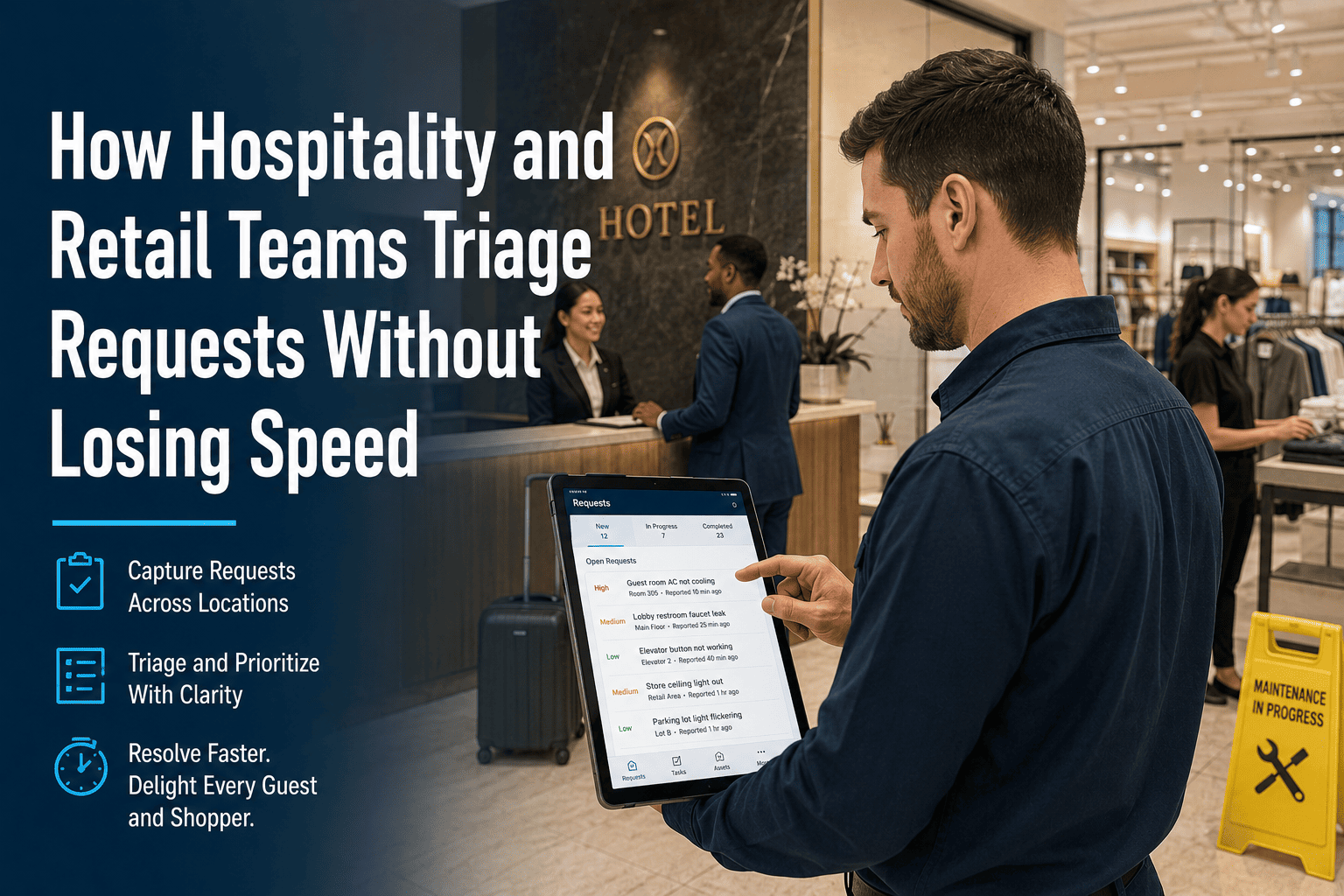
How Hospitality and Retail Teams Triage Requests Without Losing Speed

Connect with Industry Experts, Share Solutions, and Grow Together!

Join Discussion Forum
hospitality-retail-guest-tenant-request-triage

Hospitality and retail environments share a maintenance challenge most industrial sites never face: the customer is in the building when the work order is created. A guest reports a leaking shower at 11pm. A tenant flags a broken HVAC unit during peak shopping hours. A flickering parking-lot light becomes a guest review or a slip-and-fall liability before the engineering team even sees the radio call. Industry data shows hotels lose 30 room-nights per negative maintenance review and 22% of Out-of-Order rooms are recoverable with structured CMMS workflows; escalated guest complaints cost properties $40,000–$120,000 annually in compensation alone. The difference between properties that protect their review score and properties that lose revenue at every shift change is one thing — a structured triage workflow that turns every radio call, every tenant ticket, every QR-code scan into a timestamped work order with a priority, an assignee, and an SLA. Start a free trial to digitise guest and tenant request triage — or book a demo to see how Oxmaint connects front-of-house requests to engineering action in under 60 seconds.

Hospitality & Retail · Request Triage · 2026

How Hospitality and Retail Teams Triage Requests Without Losing Speed

A shared workflow for customer-facing environments that need fast response and organised maintenance queues. See how hotels, malls, and retail portfolios cut response time, protect review scores, and stop losing revenue to OOO rooms or store closures.

Live in 4 weeks — no PMS rebuild, no heavy implementation, measurable response-time gains in the first 30 days.
30Room-nights lost per negative maintenance review at a typical hotel (Cornell hospitality research)
22%Reduction in Out-of-Order rooms after deploying structured CMMS-based triage (AHLA benchmark)
$120KAnnual guest compensation cost for escalated complaints at 200+ room properties without integrated triage
41%Reduction in reactive callouts within first year of digital work order triage at hospitality properties

What Structured Request Triage Actually Is

Structured request triage is the workflow that turns an unstructured customer-facing complaint — a radio call, a tenant phone message, a guest text, a QR-code scan in a corridor — into a digital work order with priority, location, assignee, SLA, and closure photo, all within seconds of the original report. It replaces the historical model — front desk writes a note, radios engineering, hopes someone gets to it — with a system where every request is timestamped from receipt and tracked to documented closure.

The model matters because hospitality and retail maintenance is judged in real time by the customer. A 90-minute response to a broken AC at 3pm is a star reduction on Google. A 4-hour delay on a tenant HVAC ticket during a heatwave is a lease renewal at risk. Properties that move from radio-and-paper triage to structured digital triage cut average response time by 40–60% and recover most of the revenue currently lost to OOO rooms or unscheduled closures — start a free trial to see what that looks like on your property data.

Six Pillars of Customer-Facing Request Triage

Six concepts separate properties that handle guest and tenant requests at scale from those that lose requests in radio static. Each one is the difference between a request closed in 20 minutes with a photo and a request that becomes a complaint at checkout.

01
Multi-Channel Intake
Front-desk app, QR scan, tenant portal, radio handoff, and PMS integration all flow into one queue — no request gets lost.
02
Auto Priority Routing
Severity rules push leaks, HVAC outages, and safety items to the top automatically — no human triage delay.
03
Location + Asset Tag
Room number, store unit, or floor zone attaches to every ticket — technicians arrive with full context, not a phone game.
04
SLA Clock
Every ticket carries a target response time — 15 minutes for VIP, 1 hour for tenant standard — visible to manager and tech.
05
Photo-Documented Closure
No ticket closes without a photo of completion — protects against repeat complaints and supports compliance audits.
06
Recurring Issue Detection
The same room, same fault, twice in 30 days auto-flags for engineering review — pattern catching, not symptom chasing.
A single unresolved guest complaint costs more than the entire annual cost of a structured CMMS — and most are caught in the first 24 hours of any new triage workflow.

Where Hospitality and Retail Triage Breaks Down

The patterns that cause triage failures show up consistently across hotels, multi-tenant retail, malls, and customer-facing F&B properties. Six recurring failure modes account for the overwhelming share of lost requests and slow responses. Teams that close even two of these gaps recover hours of engineering productivity per week and protect their review scores in the first month — start a free trial to map your own gaps.

Radio-Only Handoff
Request shouted across a radio channel during a shift change — half the details lost before the technician arrives.
Paper Ticket Stack
A clipboard at the engineering desk holds the day's tickets — no SLA, no priority, no manager visibility.
No SLA Clock
Every request feels equally urgent — leaks compete with bulb changes for the same technician's attention.
PMS-CMMS Disconnect
Front desk shows the room as ready, engineering still has it OOO — same property, two truths, lost revenue.
Repeat Faults Untracked
Same VIP suite, same plumbing fault, three guests in a row — no system links the tickets, the pattern stays invisible.
Compliance Gaps
Fire, Legionella, and elevator inspections live in a separate binder — auditors find gaps engineering thought were covered.

How Oxmaint Structures Request Triage End-to-End

Oxmaint turns the six pillars into one connected workflow — intake, priority, assignment, response, and closure are all in the same system, all timestamped, all visible to managers in real time. The PMS pushes guest requests directly into the queue. Tenants submit through a portal that auto-tags the unit. QR codes on every asset let any team member raise a ticket in seconds. Start a free trial to see triage on your own property data.

PMS-CMMS Integration
Opera, Mews, Cloudbeds, and major retail property systems push room/unit status both ways — no double truth.
QR Code Asset Tags
Every room and store unit has a scannable tag — housekeeping, security, or guests can raise a ticket in 10 seconds.
Priority & SLA Engine
Severity rules auto-prioritise leaks, HVAC, and safety items, then start the SLA clock visible to manager and tech.
Tenant & Guest Portal
Self-service request submission with auto-tagged location and severity — front desk and tenant managers stop fielding calls.
Photo-Locked Closure
No work order closes without a completion photo — protects review score and supports compliance audit on demand.
Compliance Cycle Tracking
Fire, Legionella, elevator, and food-safety inspections run on the same platform — one audit-ready record per property.
Hospitality teams using structured CMMS triage cut Out-of-Order rooms by 22% — every recovered OOO room is direct revenue back on the books.

Radio & Paper Triage vs Structured Digital Triage — Side by Side

The gap between traditional and structured triage is widest in the moments customers actually notice — the first 20 minutes after a request is raised, the first response photo, the time-to-close on a VIP ticket. The comparison below is built from properties that completed the transition over a single quarter.

Triage DimensionRadio & PaperStructured Digital Triage
Intake channelRadio call or paper noteApp, QR, portal, PMS — unified queue
Priority assignmentVerbal, inconsistentSeverity rules, automatic
Average response time45–90 min typical15–30 min typical
Closure evidenceVerbal reportPhoto-locked, timestamped
Repeat fault detectionNone — manual recallAuto-flagged after 2nd occurrence
Manager visibilityEnd-of-shift summaryReal-time SLA dashboard
OOO room recoveryManual reconciliationPMS auto-syncs on closure

ROI After Digital Triage Rollout

The numbers below come from hospitality and retail properties that completed a 4–12 week move from radio-and-paper to structured digital triage. The pattern is consistent across single hotels, branded portfolios, mall operators, and multi-tenant retail centres — the payback is typically the first quarter of recovered OOO room revenue.

−41%
Reduction in reactive callouts within first 12 months of structured triage rollout
Pattern detection on repeat tickets converts firefighting work into scheduled PM.
+22%
Recovery of Out-of-Order rooms back into sellable inventory
PMS auto-syncs on closure — no rooms stuck in limbo between engineering and front desk.
22 min
Average guest complaint resolution time with PMS-CMMS connected workflow
Front desk can proactively communicate with the guest before the issue becomes a review.
400%+
First-year ROI documented at hotels deploying connected request triage
Combination of faster closure, lower compensation costs, and protected review scores.
Three Outcomes Operations Leaders See in 30 Days
Every guest, tenant, and front-desk request flows into one prioritised, SLA-tracked queue
OOO rooms and closed retail units recover faster — PMS reflects engineering status in real time
Repeat-fault patterns surface automatically — engineering catches them before guests do

Frequently Asked Questions

Does Oxmaint integrate with our PMS — Opera, Mews, or Cloudbeds
Yes — bidirectional integration with major hospitality PMS platforms is supported. Guest checkout triggers deep-clean and PM cycles automatically, and engineering work orders push room status back to the PMS so front desk and reservations always see the same truth.
How does the triage workflow handle peak periods like a Saturday night or holiday weekend
Severity rules and the SLA clock route urgent items to the top of the queue regardless of volume. Managers see live counts of open VIP, leak, HVAC, and safety tickets with response-time clocks visible at a glance. The audit trail makes it easy to evidence response performance for ownership review.
Can tenants in a multi-tenant retail centre submit their own tickets
Yes — the tenant portal lets unit operators submit requests directly with auto-tagged location, photo upload, and severity. Property managers stop being the inbox for every tenant call, and audit trails are clean for lease compliance.
How fast can we go live without disrupting guests or tenants
Most properties deploy in 4 weeks — asset registry import, QR tag print and place, PMS integration, and team training are templated. No IT-side build, no implementation fee, measurable response-time gains within the first 30 days.
Decision Point

Stop Losing Revenue at Every Shift Change

Turn every guest and tenant request into a prioritised, SLA-tracked, photo-closed work order — and watch the review score climb.
Used by hospitality and retail operations teams across 200+ properties — live in 4 weeks, no IT project.
By Jack Edwards

Experience
Oxmaint's
Power

Take a personalized tour with our product expert to see how OXmaint can help you streamline your maintenance operations and minimize downtime.

Book a Tour

Share This Story, Choose Your Platform!

Connect all your field staff and maintenance teams in real time.

Report, track and coordinate repairs. Awesome for asset, equipment & asset repair management.

Schedule a demo or start your free trial right away.

iphone

Get Oxmaint App
Most Affordable Maintenance Management Software

Download Our App