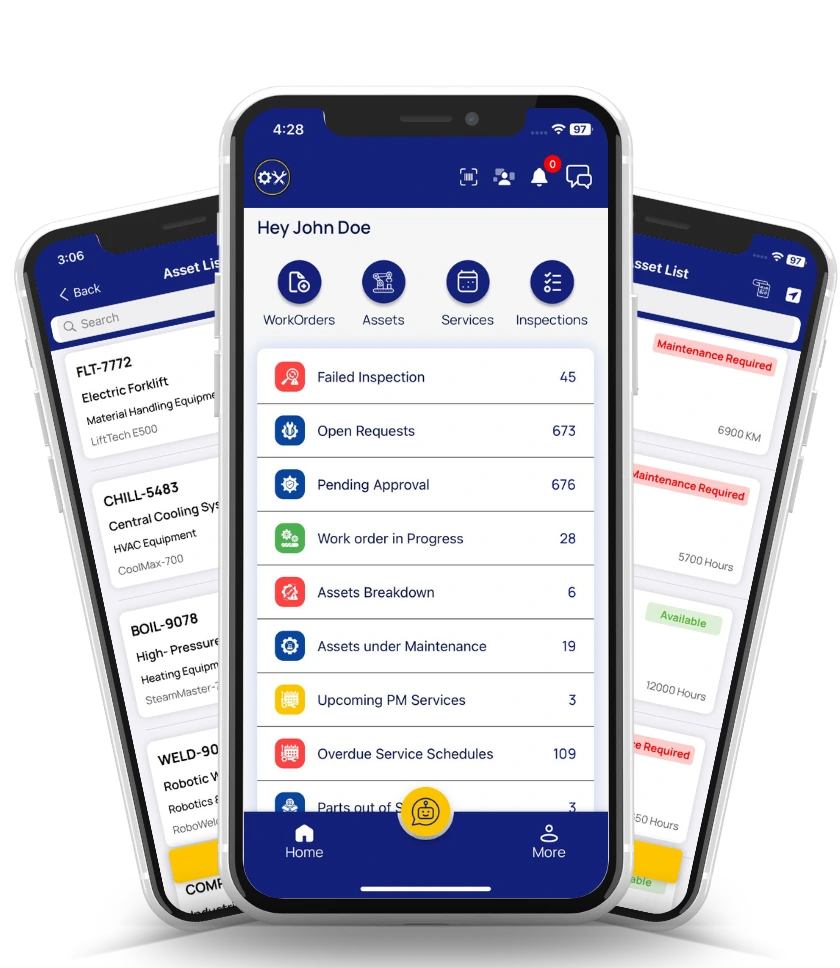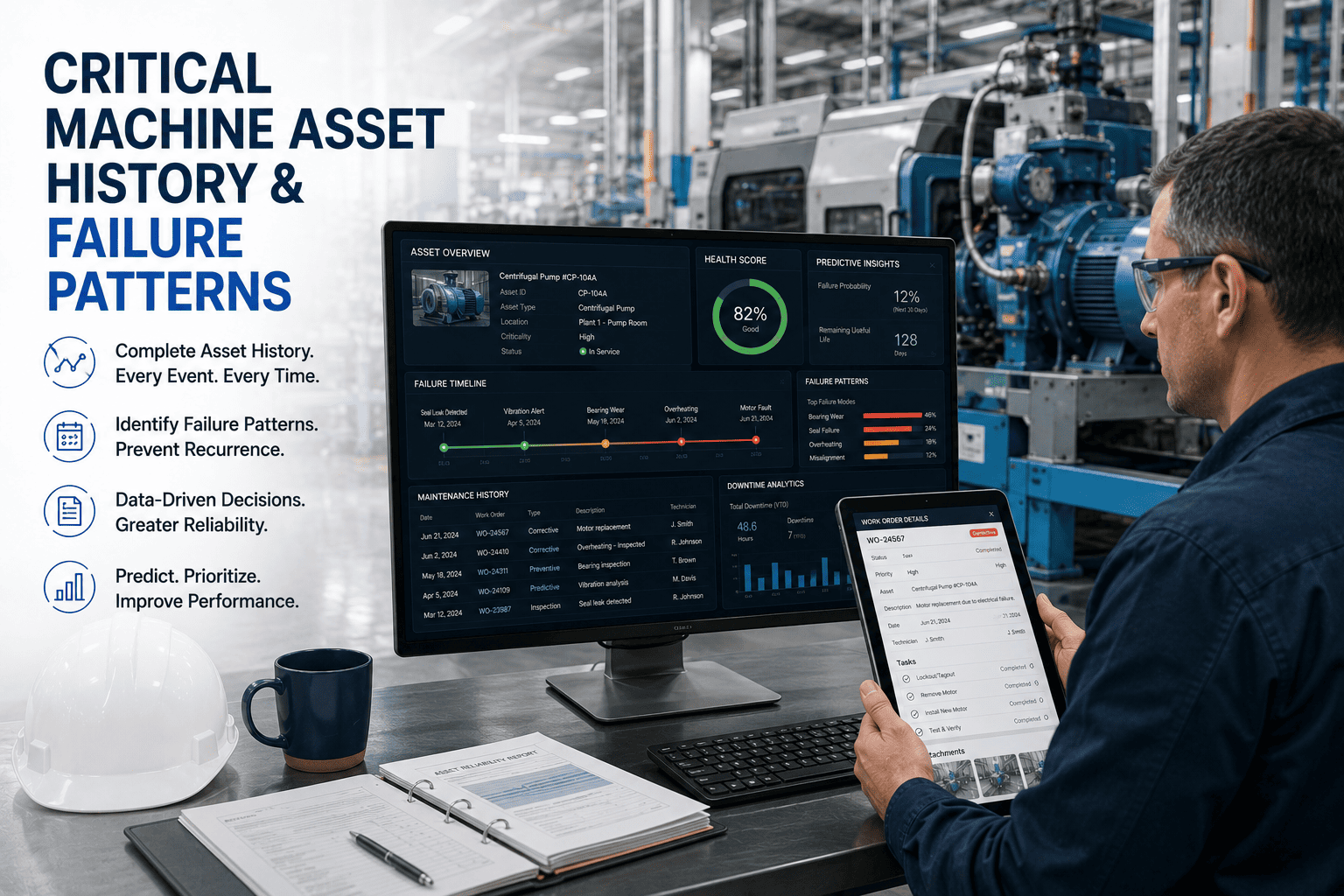
Critical machine asset history is the single highest-leverage maintenance dataset most manufacturers never build. Every breakdown, repair, sensor reading, root-cause note, spare-part swap, and operator log carries a signal — and when these signals are scattered across paper logbooks, technician notebooks, Excel files, and three different ERP modules, the plant loses the one input that drives reliability gains: the ability to see what fails, how often, why, and at what cost. Plants that consolidate critical asset history into a structured CMMS reduce recurring breakdowns by 35–55% within the first 18 months and shift between USD 400K and USD 2.1M per line from reactive repair into planned work. Oxmaint builds a complete failure-history record against every critical asset using Asset Management, Predictive Maintenance, Work Order Management, and Reports & Analytics — so MTBF, MTTR, and failure-mode patterns become measurable, comparable, and actionable. To see how your assets surface inside this framework, start a free trial or book a demo for a walkthrough.
The Cost of Flying Blind on Asset History
A critical machine asset history record is the complete time-ordered record of everything that has happened to a single asset — installations, calibrations, lubrications, inspections, failures, repairs, parts swaps, sensor readings, operator handovers, and cost data — linked to the specific component, work order, and technician involved. It is not a maintenance log. It is the operating biography of the machine. When the record is complete and queryable, reliability engineers can run failure-mode analysis (FMEA), pareto failure causes, calculate true MTBF and MTTR, and identify which assets justify a CapEx replacement instead of one more rebuild.
Most plants believe they have asset history. What they actually have is fragmented evidence — fields in CMMS that were never populated, paper records that never made it to the system, and ERP cost data that was never linked back to the failure event that caused it. Oxmaint consolidates all of this into a single asset record per critical machine. To see how your asset hierarchy maps in, start a free trial or book a demo.
The Eight Pillars of a Complete Asset History Record
A truly defensible asset history record contains eight categories of data, each one feeding a different reliability decision downstream.
Why Most Plants Cannot Find Their Failure Patterns
Six recurring data and process failures that keep critical asset history fragmented, incomplete, and unusable for reliability decisions.
Each of these gaps quietly inflates maintenance cost and CapEx — which is why reliability teams start a free trial to consolidate one critical asset class first, or book a demo for the failure-mode analytics dashboard.
How Oxmaint Builds Defensible Asset History
Six Oxmaint capabilities combine to convert scattered records into a single, queryable critical asset history — and from there, into reliability decisions.
Reliability and maintenance leaders typically pilot Oxmaint on their top 5–10 bad-actor assets first — which is why most teams start a free trial on a single critical asset class, or book a demo to see live MTBF and pareto outputs.
Fragmented Asset History vs. Oxmaint Unified Record
The operational gap between plants without structured asset history and those running Oxmaint — measured across the data points that drive reliability decisions.
| Reliability Dimension | Fragmented History Plant | Oxmaint Unified History |
|---|---|---|
| MTBF Per Critical Asset | Unknown or roughly estimated | Calculated live, trended monthly |
| MTTR Per Failure Mode | Not computed | Auto-calculated from work order data |
| Failure Mode Classification | Free-text comments only | ISO 14224-coded on every closure |
| Repeat Failure Visibility | Discovered only after multiple events | Flagged on the second occurrence |
| Cost of Ownership Per Asset | Cost trapped in ERP, never linked back | Full TCO per asset, year-over-year |
| Repair vs Replace Decision | Tribal knowledge, gut feel | Data-driven from history + RUL signals |
| Tribal Knowledge Retention | Lost when technician leaves | Captured in asset record permanently |
| Reactive vs Planned Ratio | 60–70% reactive typical | Inverts to 60–70% planned within 18 months |
ROI & Reliability Outcomes from Oxmaint Asset History
Measurable outcomes manufacturing reliability teams achieve within 12–18 months of consolidating critical asset history into Oxmaint.
These outcomes are what reliability engineers and maintenance directors carry to VP Operations for portfolio rollouts — which is why teams start a free trial on a bad-actor asset class, or book a demo to see the analytics dashboard.
Critical Asset History FAQ
Can Oxmaint migrate our existing CMMS and paper history into the new record
How does Oxmaint enforce ISO 14224 failure coding
Does Oxmaint connect to our existing SCADA and condition-monitoring sensors
How long until we see pareto failure patterns from our own data
Stop Repeating the Same Breakdown Every Quarter
Turn every critical machine into a full failure-history record on Oxmaint. Used by reliability teams managing 10,000+ assets across heavy industry, manufacturing, and process plants.