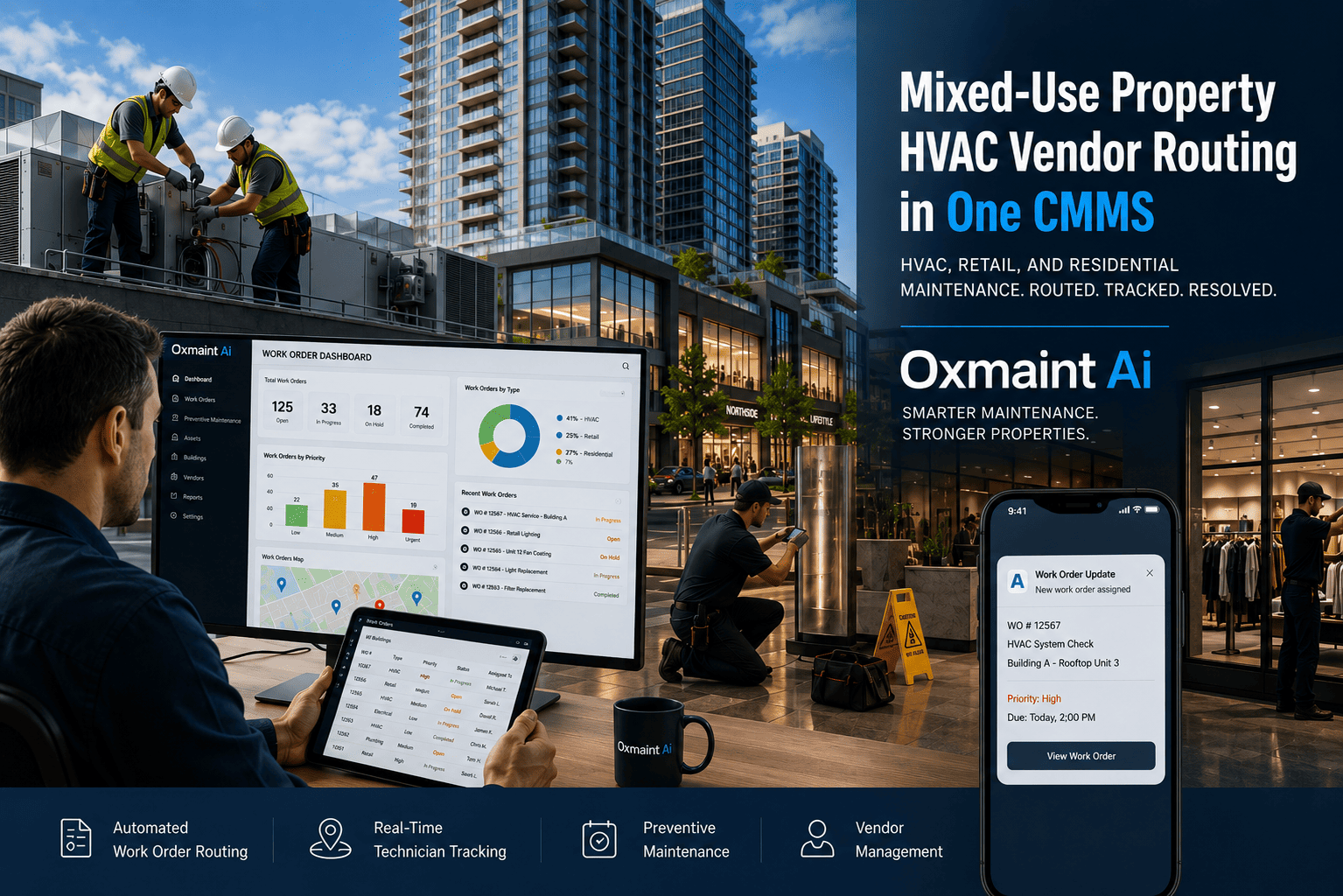
How Mixed-Use Properties Can Route HVAC, Retail, and Residential Work Orders in One CMMS

Connect with Industry Experts, Share Solutions, and Grow Together!

Join Discussion Forum
mixed-use-property-hvac-vendor-routing-cmms

A residential tenant calling at 2 AM about a heat outage, a retail tenant reporting refrigeration failure at 6 AM with food safety on the line, and an office tenant escalating an elevator entrapment at 9:15 AM are not three work orders — they are three different SLA clocks, three different escalation paths, and three different financial exposures running in parallel inside the same property. For mixed-use portfolio managers, the question is not whether maintenance happens — it is whether it happens fast enough to protect the lease, the tenant, and the asset class economics underneath. Most teams still route this work through phone calls, email threads, and shared spreadsheets that flatten every request into the same generic ticket. The result is missed SLAs, vendor overruns, and reactive spend that absorbs 60% or more of the maintenance budget. A unified CMMS routing layer is what separates portfolios that grow profitably from portfolios that bleed quietly every month.

See how much reactive HVAC spend you can recover in a 30-minute audit of your routing workflow.
Real-time SLA visibility per use type Vendor scorecards by response time CapEx forecasts grounded in actual data
Industry Reality Check

Why Mixed-Use Properties Lose Money on Vendor Routing

60%+
Of mixed-use work orders run reactive — preventive scheduling reduces emergency spend by 45–65%
$10B+
US annual HVAC repair and maintenance spend across commercial and residential portfolios
22–28%
Lower HVAC cost per sqft reported by properties using CMMS vendor management vs. email/spreadsheets (BOMA 2023)
4.8×
Emergency repair cost multiplier vs. planned maintenance — the hidden tax on reactive routing
Definition

What Mixed-Use Work Order Routing Actually Means

Mixed-use work order routing is the operational discipline of taking every maintenance request — from a residential tower, a retail bay, an office floor, or a shared common area — and directing it to the correct technician, vendor, or escalation path based on use type, urgency tier, lease responsibility, and SLA window. It is not ticket triage. It is decision architecture: every request enters the system with structured metadata, and the routing engine determines who acts, when, and against which contractual obligation.

The mixed-use complication is that the same physical building runs three or four parallel SLA frameworks simultaneously. A residential heat outage is governed by habitability law and the lease. A retail refrigeration failure is governed by food safety regulation and a triple-net cost allocation clause. An office HVAC complaint is governed by tenant satisfaction metrics tied to renewal probability. When routing is manual, the property manager becomes the single point of failure — and the moment they go on PTO or get pulled into an emergency, the entire portfolio loses SLA discipline. A structured CMMS routing layer removes the manager-as-router bottleneck and turns routing into a system that scales — start a free trial and see how Oxmaint maps your property hierarchy in under an hour, or book a demo and we will walk through routing logic for your specific tenant mix.

Routing Framework

The Six Pillars of a Mixed-Use CMMS Routing Engine

Effective routing is not a single rule — it is a layered framework where six independent decisions stack on top of every incoming work order. Each pillar below maps to a routing decision the CMMS makes automatically once the property hierarchy, vendor roster, and SLA matrix are configured.

01
Use-Type Classification
Every asset is tagged residential, retail, office, or common area. The tag determines which vendor pool, SLA, and lease responsibility apply.
02
Urgency Tier Assignment
P1 life safety, P2 business disruption, P3 comfort, P4 cosmetic. Each tier triggers a different vendor pool and response clock.
03
Lease Responsibility Logic
Triple-net, modified gross, full-service gross — the lease determines whether the landlord or tenant pays. Routing must mirror the lease.
04
Vendor Skill Matching
HVAC, plumbing, electrical, refrigeration, elevator — each trade has a primary and backup vendor pre-mapped to the property.
05
SLA Clock Activation
The moment a ticket is created, the SLA timer starts. Auto-escalation fires if the vendor has not accepted within the response threshold.
06
Cost Allocation Routing
Invoice flows to the correct GL account — operating expense, CAM reconciliation, tenant chargeback, or capital improvement bucket.
Most mixed-use portfolios lose 20–40% of maintenance budget to untracked routing decisions, duplicate vendor visits, and invoice errors that never get audited.
Signature Workflow

How a Single Work Order Routes Through Three Use Types

Incoming Request
Work Order Created
Tenant, technician, or sensor opens a request in Oxmaint with asset, use-type, and severity captured at intake.

Route A
HVAC / Common Areas
SLA: 4–8 hr response
  • Internal tech assignment
  • Shared CAM cost allocation
  • BMS sensor integration
Route B
Retail / Commercial
SLA: 2–4 hr response
  • Vendor dispatch with PO
  • Tenant chargeback flagged
  • Revenue-impact priority
Route C
Residential Units
SLA: 24–48 hr standard
  • Resident notification trigger
  • Unit-level cost tracking
  • Habitability rules applied
Where the Money Leaks

Industry Pain Points Killing Mixed-Use Portfolio Margins

Six pain patterns recur across nearly every mixed-use portfolio audited. Each one is a routing failure dressed up as a vendor problem, a tenant problem, or a budget problem. Fix the routing layer and every one of these compresses or disappears entirely — which is why operations teams switching to structured CMMS routing typically see 22–28% lower HVAC cost per square foot inside the first 12 months. Book a demo to see the routing diagnostic Oxmaint runs against your current workflow.

Manager-as-Router Bottleneck
Property managers manually triaging every request become the single point of failure. PTO, illness, or one urgent escalation collapses the routing layer entirely.
SLA Blindness Across Use Types
Without per-use SLA tracking, retail refrigeration failures and residential heat outages get treated with the same urgency — usually wrong on both.
Vendor Invoice Drift
Without scope-to-invoice matching, vendors bill above authorized estimate and the discrepancy goes unnoticed. Industry averages show 8–14% invoice inflation.
CAM Reconciliation Disputes
Mixed-use properties allocate maintenance costs across tenant categories. Manual routing produces incomplete audit trails that retail tenants challenge at year-end CAM reconciliation.
Duplicate Vendor Dispatches
Without a centralized routing log, two managers send two different HVAC vendors to the same building on the same day. The second invoice is pure waste.
Compliance Documentation Gaps
Fire safety, elevator, HVAC inspection records scattered across email, spreadsheets, and vendor portals — auditors find gaps every time.
The Solution Layer

How Oxmaint Routes HVAC, Retail, and Residential Work in One System

Oxmaint replaces the property-manager-as-router model with a structured routing engine that operates on configured rules, not memory. Six core capabilities make this work at portfolio scale across mixed-use properties. The result: faster SLA compliance, lower emergency dispatch rates, and an auditable cost trail that holds up to any CAM reconciliation review — start a free trial and configure your first property hierarchy in under 60 minutes.

Portfolio Hierarchy with Use-Type Tagging
Properties broken down to portfolio, building, floor, suite, and asset — each tagged residential, retail, office, or common area for instant routing decisions.
Per-Use SLA Matrix
P1 life safety, P2 business disruption, P3 comfort, P4 cosmetic — each tier with its own response clock that varies by use type.
Vendor Pool with Auto-Dispatch
Primary and backup vendors mapped to each trade and each building. Auto-escalation if the primary does not accept within threshold.
Vendor Scorecard Tracking
Response time, first-call resolution, invoice accuracy, and tenant satisfaction tracked per vendor — visible at the portfolio dashboard level.
Lease-Aware Cost Routing
Every work order tagged to the lease clause that governs cost recovery — operating expense, CAM, tenant chargeback, or CapEx bucket.
Mobile-First Technician Workflow
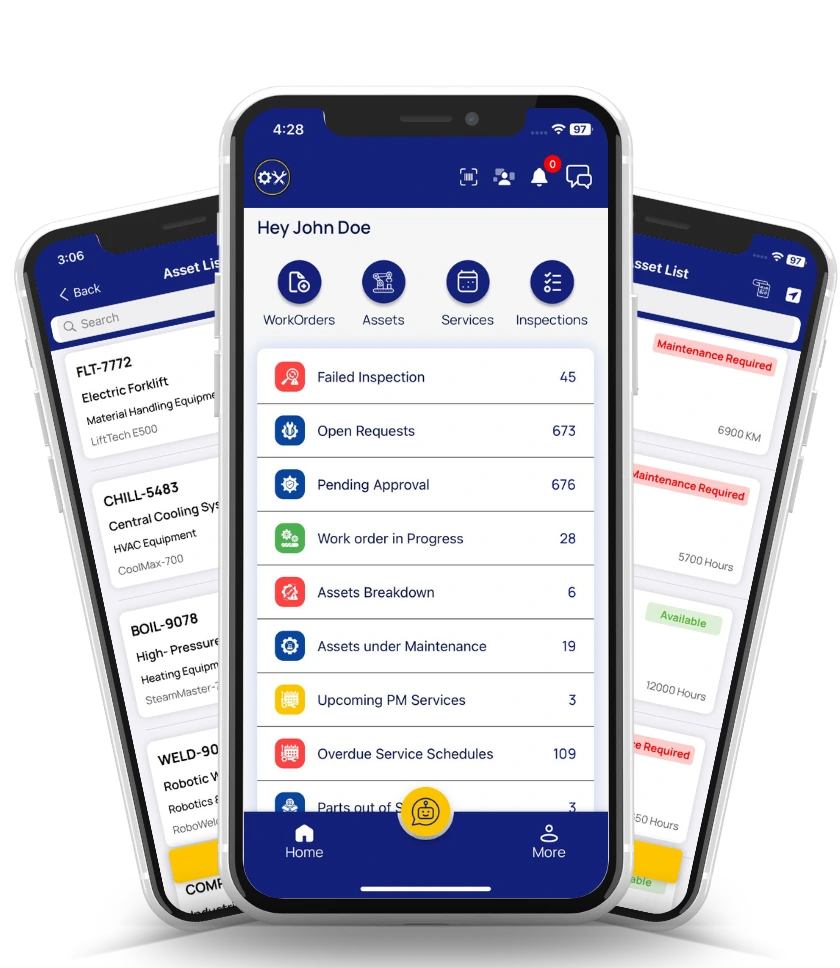
Vendors and in-house techs receive work orders on mobile, complete with site context, asset history, and photo evidence upload at completion.
Properties using CMMS-based vendor management report 22–28% lower HVAC maintenance costs per square foot — concentrated in emergency dispatch reduction and invoice error recovery.
Before vs After

Manual Routing vs. CMMS-Driven Routing: The Operational Comparison

The shift from email-and-spreadsheet routing to structured CMMS routing is not a tooling upgrade — it is an operational model change. The table below shows what each workflow stage looks like in both modes.

Workflow Stage Manual Email and Spreadsheet Routing Oxmaint CMMS Routing
Tenant Submits Request Phone call or email to property manager — captured in inbox or on paper Tenant portal or QR code scan — structured request with use type, location, urgency auto-classified
Routing Decision Manager personally decides vendor, priority, and dispatch order based on memory Routing engine assigns vendor pool, SLA tier, and lease responsibility from configured rules
Vendor Dispatch Phone call to vendor; no acceptance timestamp; verbal scope Auto-dispatched work order with full scope, asset history, and photo context; vendor acceptance logged
SLA Tracking No real-time visibility; SLA breach discovered after tenant complaint Live SLA clock per work order; auto-escalation if vendor does not respond within threshold
Cost Allocation Invoices manually sorted between operating, CAM, and tenant chargeback at month-end Auto-allocated at work order creation based on lease and asset type — clean CAM reconciliation
Audit Trail Fragments across email threads, spreadsheets, and vendor portals Single timestamped record per work order — request to completion, with photo and signature
Vendor Performance Review Done annually from memory and complaint volume Real-time scorecards on response time, first-call resolution, invoice accuracy, tenant satisfaction
Reactive vs. Planned Mix 60%+ reactive — emergency premiums consume the budget Reactive drops to 25–35% as PM scheduling absorbs failure-prone assets before they break
Measurable Outcomes

ROI and Results: What Mixed-Use Portfolios Recover with Oxmaint

These outcome numbers are drawn from BOMA portfolio studies, Oxmaint property management deployments, and industry benchmarks across HVAC service contracts in commercial buildings — and they represent the financial recovery that compounds quarter over quarter once routing is structured. Start a free trial to model your portfolio's recovery scenario.

22–28%
Lower HVAC cost per sqft
Reported by properties using CMMS vendor management vs. email and spreadsheets (BOMA 2023)
45–65%
Emergency work order reduction
From shifting reactive work to scheduled PMs across HVAC, plumbing, and elevator assets
38%
Of emergency spend concentrated
In a small subset of buildings and assets — visible only with portfolio-level analytics
8–14%
Invoice inflation recovered
Through scope-to-invoice matching against authorized work order estimates
34%
Vendor cost growth eliminated
Three-year HVAC vendor cost creep typical when performance is not tracked against SLA
30 days
Time to first measurable result
From go-live to first vendor scorecard and CAM cost allocation report — no heavy implementation
Common Questions

Mixed-Use CMMS Routing FAQ

How long does it take to configure Oxmaint for a mixed-use portfolio?
A typical 5–15 building mixed-use portfolio is configured in 2–4 weeks. The hierarchy (portfolio, property, system, asset), vendor pools, and SLA matrix go in first; PM scheduling and CapEx forecasting layer on after the routing engine is producing clean data.
Can Oxmaint handle different SLA tiers for residential, retail, and office tenants in the same property?
Yes. Each asset is tagged by use type, and each use type has its own SLA matrix. A retail refrigeration failure triggers a different response clock than a residential heat outage, and both are tracked separately in the SLA dashboard.
How does the vendor scorecard work?
Every vendor accumulates a real-time record across four metrics: response time against SLA, first-call resolution rate, invoice accuracy against scope, and tenant satisfaction. The scorecard surfaces underperforming vendors before contract renewal — no manual review required.
Does Oxmaint support CAM reconciliation reporting for commercial tenants?
Yes. Every work order is tagged to the cost-recovery bucket at creation — operating expense, CAM-recoverable, tenant chargeback, or CapEx. Year-end CAM reconciliation reports pull directly from the work order ledger with a full audit trail.
Stop the Reactive Spend Cycle

Route Every Work Order Through One System. Recover the Margin.

Mixed-use portfolios that move from email-and-spreadsheet routing to a structured CMMS routing layer recover 22–28% on HVAC cost per square foot and cut emergency dispatches by half. Used by operations teams managing 10,000+ assets. See measurable results in the first 30 days.
Real-time SLA visibility across residential, retail, and office
Vendor scorecards on response time, invoice accuracy, satisfaction
CAM-ready cost allocation with full audit trail
No heavy implementation required  •  Works across multi-site portfolios  •  Live in days, not months
By Jack Edwards

Experience
Oxmaint's
Power

Take a personalized tour with our product expert to see how OXmaint can help you streamline your maintenance operations and minimize downtime.

Book a Tour

Share This Story, Choose Your Platform!

Connect all your field staff and maintenance teams in real time.

Report, track and coordinate repairs. Awesome for asset, equipment & asset repair management.

Schedule a demo or start your free trial right away.

iphone

Get Oxmaint App
Most Affordable Maintenance Management Software

Download Our App