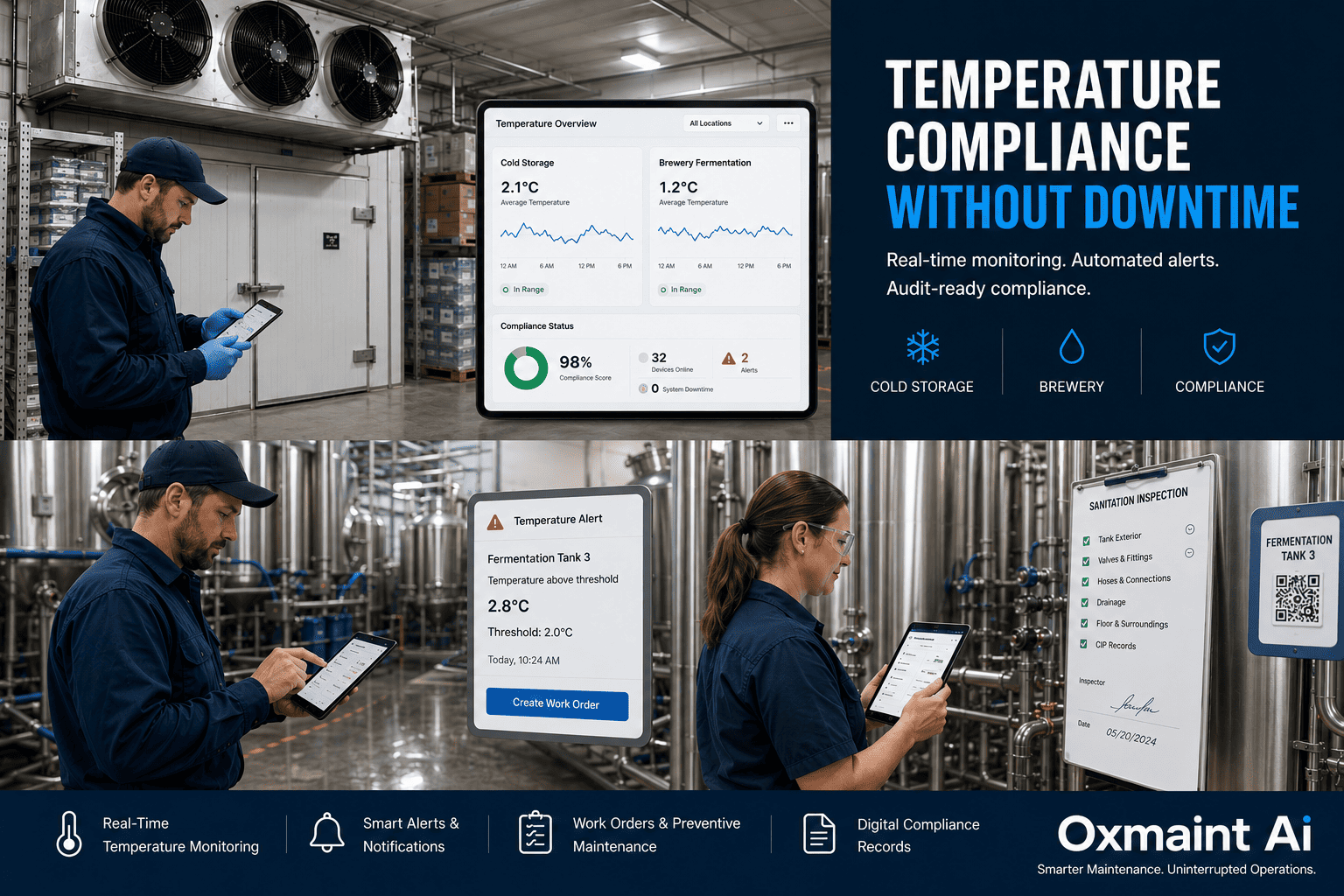
A compressor on a 32°F cold room overworks for three weeks on dirty condenser coils that nobody flagged, then fails at 11 PM on a Friday. By Monday morning, the cleanup is $34,000 in spoiled product, 18 hours of downtime, an emergency parts shipment at 3× list price, and an FDA auditor visit the following week that finds incomplete temperature documentation. The story is functionally identical in a brewery — a glycol chiller drifts 4°F above setpoint mid-fermentation, the lager batch develops off-flavors, and 80 barrels of product gets dumped. In every refrigeration-dependent operation, the failure pattern is the same: gradual degradation invisible to the people in the building, missed inspections that exist on paper but never make it to the floor consistently, and compliance documentation that only matters until the moment an inspector asks for it. Temperature compliance is not a thermometer problem. It is a maintenance discipline problem.
See how much spoilage risk and compliance exposure you can eliminate with a structured cold chain maintenance workflow.
Temperature logs auto-capturedPM schedules that actually get doneFDA and OSHA-ready audit trails
Global cold storage market in 2025, growing at 9.4% CAGR — maintenance discipline is now a competitive moat
40%
Of brewery electricity consumption goes to refrigeration alone — efficiency loss compounds operating cost
99.9%
Industry temperature compliance benchmark for cold chain operators — anything less risks product and audit failures
$125K–$500K
Average cost of a single ammonia release incident under OSHA Process Safety Management requirements
Definition
What Temperature Compliance Maintenance Actually Means
Temperature compliance maintenance is the operational discipline of running refrigeration, cooling, sanitation, and temperature-sensitive assets at specification — every shift, every day, every audit cycle — with documented evidence that every inspection happened, every deviation was addressed, and every corrective action closed the loop. It applies across cold storage warehouses, food processing plants, breweries, distilleries, pharmaceutical storage, and any operation where product integrity depends on temperature stability.
The discipline has three layers: structured preventive maintenance on the critical refrigeration components (compressor, condenser, evaporator, defrost system, refrigerant charge, controls), real-time temperature monitoring with deviation alerts, and audit-ready documentation showing inspections, calibrations, and corrective actions in a single retrievable record. Cold storage facilities investing in this discipline report measurable reductions in spoilage, FDA findings, and energy waste — and breweries running the same playbook protect both batch consistency and PSM compliance. Start a free trial and configure your first refrigeration PM schedule in an afternoon, or book a demo scoped to your specific cold chain workflow.
The Critical Six
Six Maintenance Disciplines Every Cold Chain Operation Needs
Six maintenance disciplines separate cold storage and brewery operations that hit the 99.9% temperature compliance benchmark from those that lose product, energy, and audit standing. Each one maps to a specific failure mode that monthly inspections and a structured CMMS catch before the failure surfaces.
01
Condenser Coil Cleaning
Dust buildup restricts airflow and forces compressor overwork. Monthly cleaning prevents the gradual head-pressure drift that ends in compressor failure.
02
Thermostat and Controller Calibration
Drift in setpoint controllers produces off-flavors in beer and product loss in cold rooms. Quarterly calibration catches drift before it shows up in product.
03
Refrigerant Charge Verification
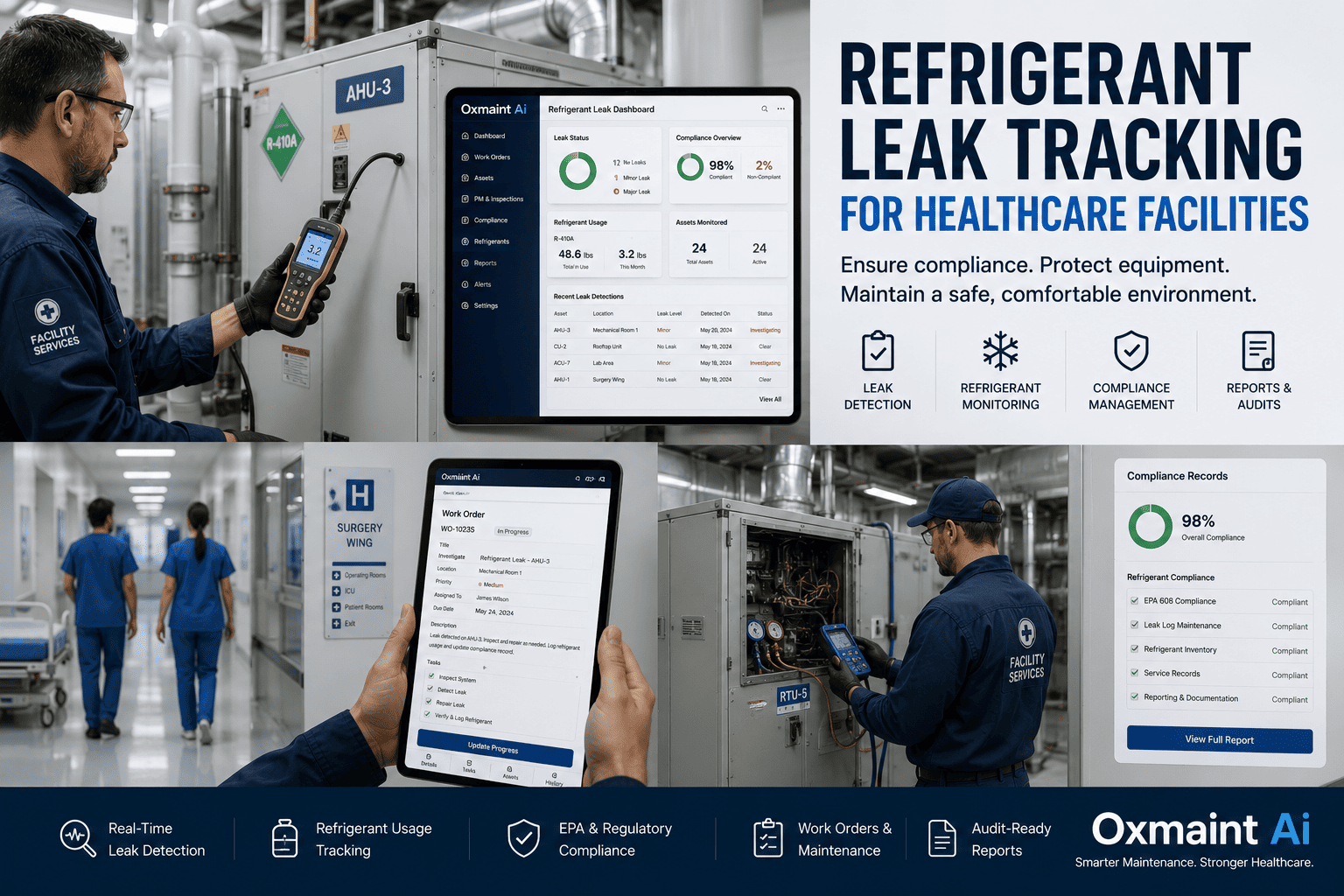
Low refrigerant cuts cooling capacity and overloads compressors. Routine inspections catch leaks before they become EPA-reportable.
04
Evaporator Defrost Cycle Audit
Frost-blocked evaporators cause uneven cooling and forced 4–8 hour manual defrost downtime. Audit defrost cycles weekly.
05
Door Gasket and Seal Inspection
Failed gaskets cause warm air infiltration, ice buildup, and 15–25% efficiency loss. Cheap to inspect, expensive to ignore.
06
Sanitation Cycle Verification
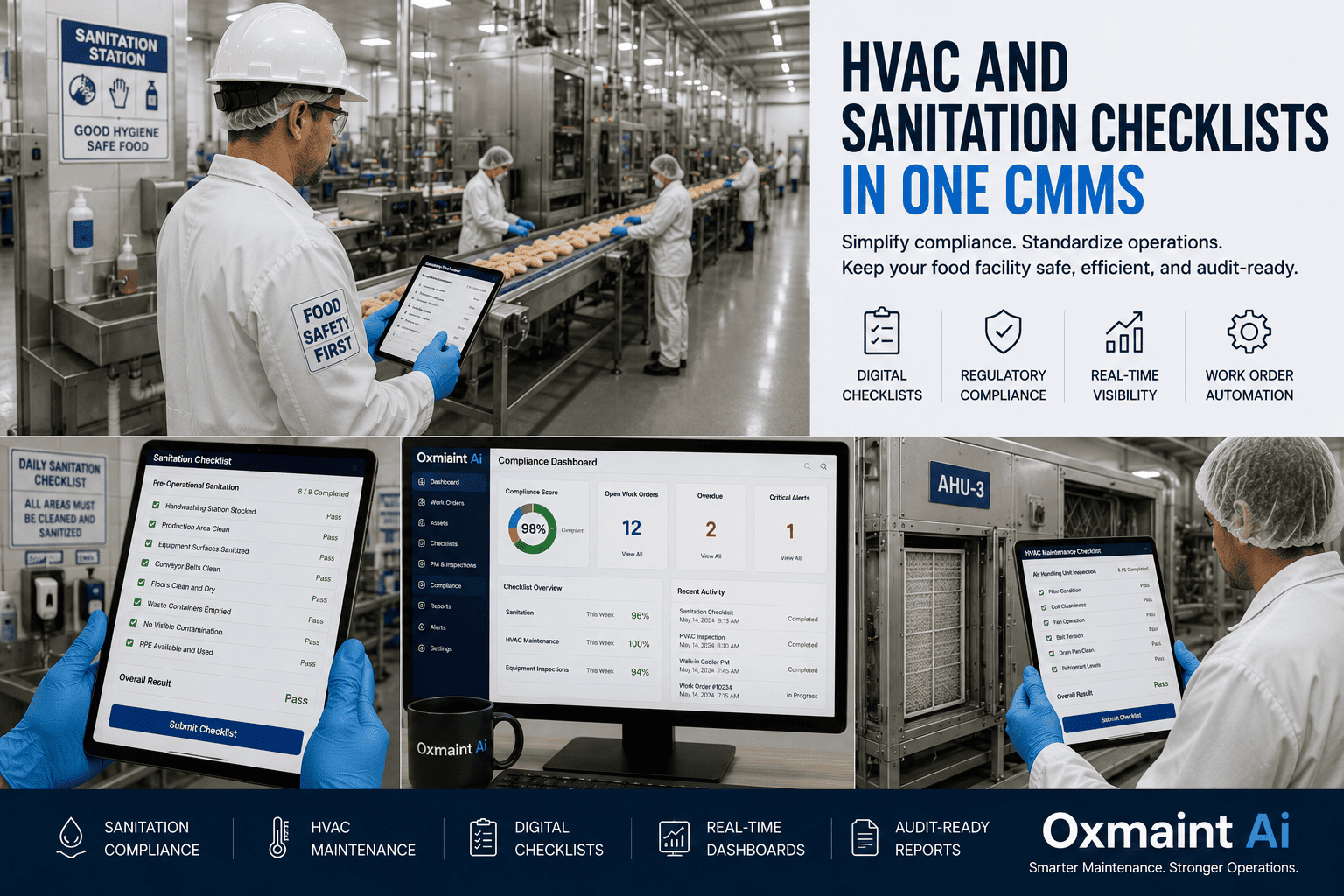
CIP and SIP cycles in breweries and food cold storage must run to spec and be documented — audit failures here cost more than the cleaning itself.
Most cold storage failures are not sudden — they are gradual, building over days through missed inspections and checklists that exist on paper but never make it to the floor.
Signature Dashboard
Live Temperature Zones at a Glance
Site Overview — Facility A
3 zones monitored continuously
In Range
Cold Storage A
-22°C
Target: -18 to -25°C
Last reading 2 min ago
Drift Warning
Fermentation Tank 4
18.4°C
Target: 16 to 18°C
WO auto-opened 4 min ago
In Range
Brite Tank Cellar
2.1°C
Target: 0 to 4°C
Last reading 1 min ago
Where Cold Chains Break
Industry Pain Points Killing Cold Storage and Brewery Margins
Six failure patterns recur across cold storage warehouses, breweries, and food processing plants. Each is a place where maintenance discipline could have prevented product loss, energy waste, or a compliance citation — but the system to enforce that discipline was missing. Operations teams switching to structured cold chain CMMS workflows recover 30–40% on emergency repair costs and protect 99.9% temperature compliance benchmarks inside the first year. Book a demo to see the cold chain dashboard configured for your facility type.
Gradual Performance Drift Goes Unseen
Head pressure inches up, suction temperature drifts, compressor amp draw rises — none of it triggers an alarm until the failure occurs.
Paper Temperature Logs
Clipboards in cold rooms get illegible, frozen, or lost. FDA auditors arrive and the temperature record for the past 90 days is incomplete.
Missed PM Cycles
Monthly coil cleaning, quarterly calibration, semi-annual refrigerant checks — without a schedule that pushes work to assigned technicians, they get skipped.
PSM Compliance Documentation Gaps
Ammonia systems with 10,000+ pounds require OSHA PSM compliance. Missing inspection records mean PHA failures and $30K–$60K cycle costs that grow.
Emergency Repair Premiums
After-hours compressor replacement runs 4–5× planned cost. Without PM discipline, every repair becomes an emergency repair.
Batch Loss From Fermentation Drift
Brewery glycol chiller drift of 4°F mid-fermentation produces off-flavors and dumped batches — 80 BBL events cost more than annual chiller maintenance.
The Oxmaint Workflow
How Oxmaint Builds Cold Chain Maintenance Into Daily Operations
Oxmaint structures cold chain maintenance around an asset hierarchy that mirrors how cold storage facilities and breweries actually run — system to subsystem to component to consumable. Four core capabilities make temperature compliance a byproduct of normal operations instead of a separate compliance project. Start a free trial and have your first PM cycle scheduled inside a single afternoon.
Refrigeration-Specific PM Templates
Pre-built templates for compressors, condensers, evaporators, glycol chillers, ammonia systems — load and customize for your assets in minutes.
Sensor-Driven Temperature Logging
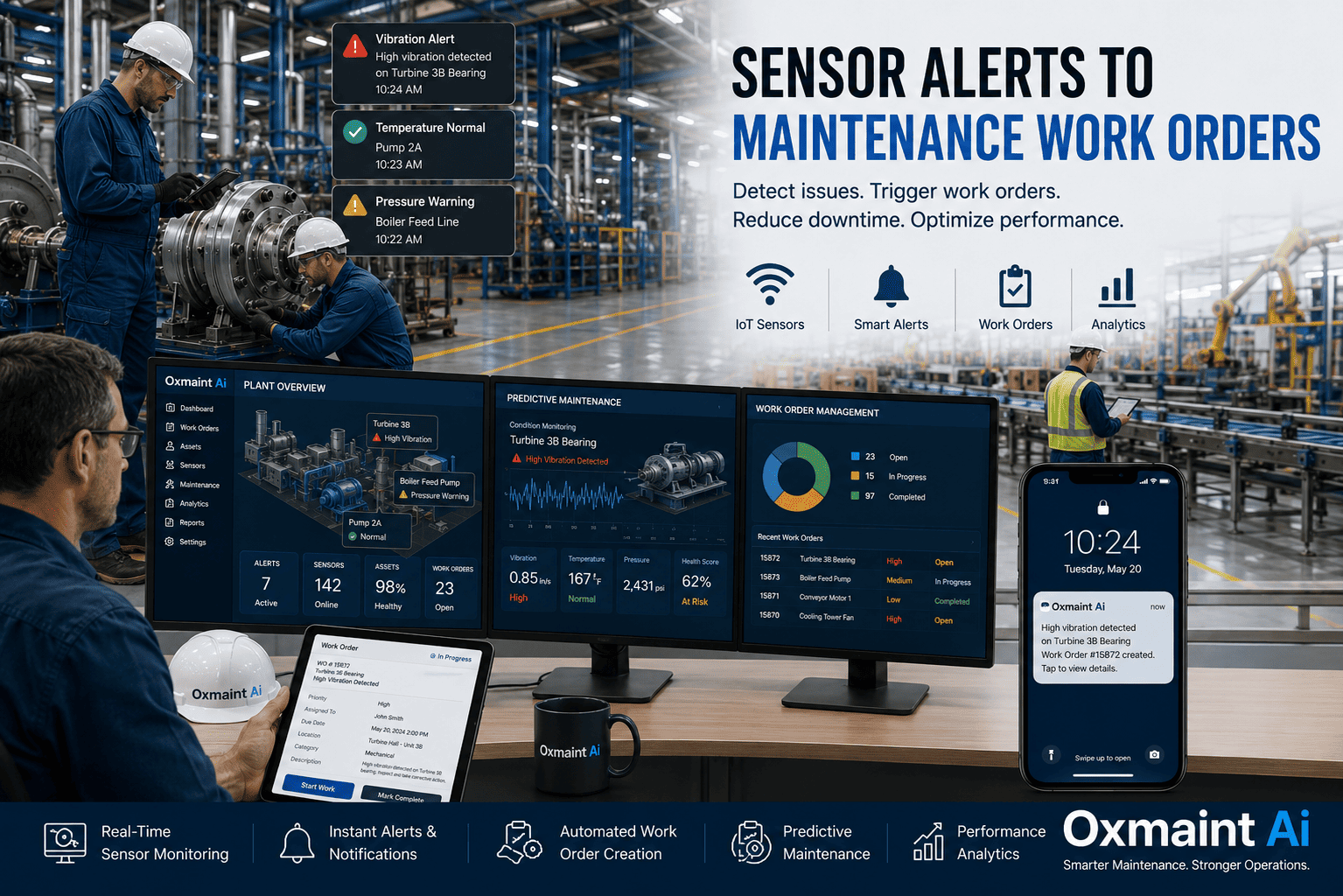
Integrate temperature sensors via standard industrial protocols — logs captured automatically, deviations auto-create corrective action work orders.
PSM and FDA Audit-Ready Trails
Every inspection, calibration, and corrective action timestamped, signed, and retrievable for OSHA PSM, FDA, and brewing safety reviews.
Spare Parts and Refrigerant Tracking
Critical compressor parts, refrigerant inventory, and consumables tracked at the storeroom level — no emergency procurement at 3× list price.
The cold storage market is growing 9.4% annually — and 19.3% CAGR through 2029 — meaning more facilities, more equipment, and more pressure on maintenance teams to hit 99.9% compliance.
Reactive vs Planned
Reactive Cold Chain Maintenance vs. Structured Oxmaint Workflow
The structural difference between reactive and planned cold chain maintenance is what determines whether the operation hits 99.9% temperature compliance or absorbs spoilage, fines, and emergency premiums quarter after quarter. The table below maps every lifecycle stage across both modes.
Workflow Stage
Reactive Cold Chain Maintenance
Oxmaint Structured Cold Chain Workflow
Coil Cleaning
Done when someone notices ice buildup — usually too late
Monthly PM auto-assigned, photo-verified, signed by technician
Temperature Logging
Paper clipboard, handwritten readings, gaps everywhere
Sensor-driven, continuous, deviation auto-creates corrective WO
Calibration Cycle
Done annually or when a problem appears
Quarterly PM with NIST-traceable calibration record stored digitally
Refrigerant Leak Detection
Caught when system can no longer hold setpoint
Monthly visual and electronic leak check with documented finding
Compressor Performance Trending
No trending — failure is the first signal
Amp draw, discharge temp, head pressure trended over time
PSM Documentation
Binder in a file cabinet, last updated unknown
Live PSM record, retrievable by date or asset in seconds
Spare Parts Availability
Emergency procurement at 3× list when failure hits
Critical parts pre-stocked based on failure history and lead time
Audit Preparation
Weeks of binder assembly before an FDA or OSHA visit
One-click audit export, fully timestamped and signed
Measured Impact
ROI and Results From Structured Cold Chain Maintenance
These outcomes are drawn from cold storage, brewery, and food processing deployments running structured cold chain maintenance workflows — they represent what teams report inside the first 6–12 months of going live. Start a free trial to model your facility's specific recovery scenario.
99.9%
Temperature compliance achievable
Industry benchmark for cold chain operators — reached through structured PM and sensor-driven logging
30–40%
Emergency repair cost reduction
By replacing reactive failures with scheduled PM on compressors, condensers, and evaporators
15–25%
Energy efficiency recovery
From clean coils, tight gaskets, optimal refrigerant charge, and properly calibrated controls
$34K+
Spoilage events prevented
A single avoided compressor failure event in a stocked cold room covers years of PM software cost
100%
PSM and FDA audit readiness
Every inspection cycle, calibration record, and corrective action available on demand
30 days
First measurable result
From go-live to first compliance dashboard, first sensor deviation catch, and first prevented event
Common Questions
Cold Storage and Brewery Maintenance FAQ
Does Oxmaint handle ammonia refrigeration system PSM compliance?
Yes. Oxmaint schedules and documents the inspection cycles, mechanical integrity testing, and operating procedure reviews that OSHA PSM requires for ammonia systems over 10,000 pounds. Every record is timestamped, signed, and retrievable for PHA cycles and compliance audits.
Can Oxmaint integrate with existing temperature monitoring sensors?
Yes. Oxmaint accepts data from standard industrial sensors via Modbus, OPC-UA, REST API, and MQTT. Temperature deviations from setpoint trigger automatic work orders so corrective action starts before product is at risk.
Is Oxmaint sized for craft breweries as well as large cold storage operations?
Yes. The hierarchy scales from a single brewery with a few glycol chillers to a multi-site cold storage operation with hundreds of compressors and ammonia systems. PM templates and inspection schedules adapt to the asset count without re-architecting the workflow.
How long does it take to deploy?
A single facility goes live in 2–4 weeks. The first PM cycle can run in the first week of deployment. Multi-site operations typically deploy in 4–8 weeks, with asset tagging, template configuration, and technician training running in parallel.
Stop Losing Product to Refrigeration Drift
Make Temperature Compliance a Byproduct of Doing the Work
Cold storage operators and breweries running Oxmaint hit 99.9% temperature compliance, cut emergency repair spend by 30–40%, and walk into every FDA, OSHA, and PSM audit with full timestamped records. Used by operations teams managing 10,000+ assets. See measurable results in the first 30 days.
Refrigeration-specific PM templates pre-built
Sensor-driven temperature logs with deviation alerts