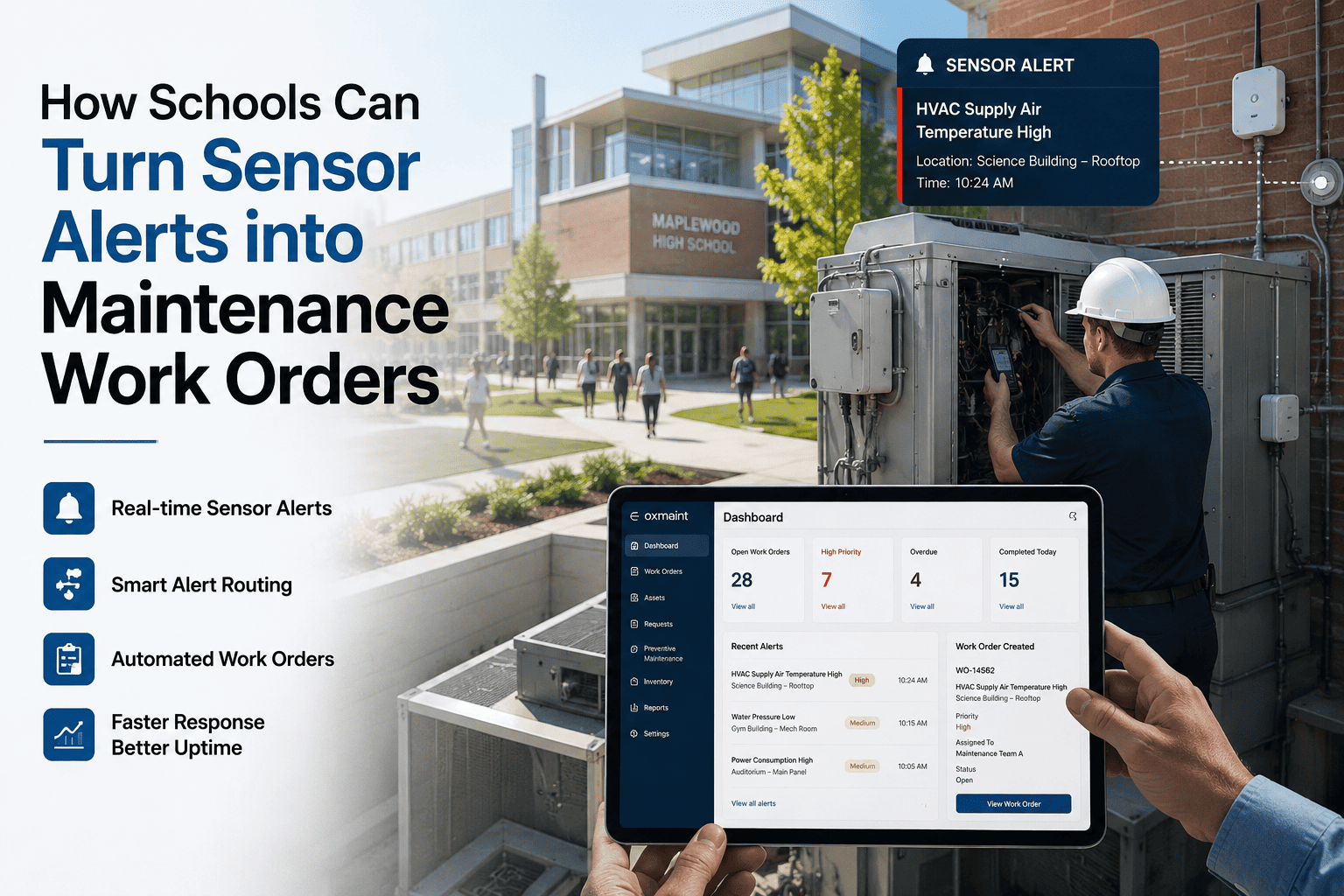
Campus facilities teams managing K-12 districts and higher education portfolios face a quiet crisis — HVAC, water, electrical, and occupancy sensors are generating thousands of alerts daily, but only a fraction translate into actual maintenance work orders. Industry data shows that over 40% of building sensor alerts in education facilities go unaddressed within their critical response window, and the gap between detection and dispatch averages 6-18 hours when facilities teams rely on manual review of BMS dashboards. The cost shows up everywhere — classrooms running 4°F above setpoint hurt student concentration and test scores, undetected water leaks cost districts an average of $14,000 per incident, and air quality breaches expose schools to OSHA and state-level health citations. The fix is not more sensors. It is automated rule-based routing that turns every meaningful alert into a work order, assigned, tracked, and closed without human triage. See how OxMaint turns campus sensor data into automated work order workflows — start a free trial or book a demo with our campus operations team.
Campus Sensors · Automated Work Orders · Education Facilities
How Schools Can Turn Sensor Alerts into Maintenance Work Orders
HVAC, water, electrical, and occupancy sensors flood facilities teams with alerts every day — and most go unaddressed in time. Discover how rule-based routing converts every meaningful campus sensor signal into a dispatched, tracked work order. From classroom temperature breaches to chiller faults, learn the framework that cuts response times by 70%+ and closes the gap between detection and action.
Used by campus operations teams managing 1,000+ buildings · Works across multi-site portfolios
Live Alert Flow
Bldg 3 HVAC · Temp 78°F
WO #4821
Dorm A · Water leak detected
WO #4822
Sci Lab · CO2 above 1500ppm
WO #4823
Gym · Air handler vibration
WO #4824
Sensor to rule to work order in seconds
The Numbers
Why Campus Sensor Automation Matters
40%
Of campus sensor alerts unaddressed in critical window
$14K
Average cost of one undetected water leak in a school
6–18hr
Manual alert-to-work-order lag in legacy operations
4.8×
Cost of reactive vs planned campus repairs
Definition
What Sensor-to-Work-Order Automation Actually Means
Sensor-to-work-order automation is the rule-based process of converting building management system signals — temperature, humidity, CO2, water flow, vibration, current draw, occupancy — directly into dispatched maintenance work orders without manual triage. Instead of a facilities director reviewing a BMS dashboard at 7am and deciding which of yesterday's 312 alerts deserved action, the CMMS receives alerts in real time, applies pre-defined rules (severity, asset criticality, time-of-day, threshold duration), and generates a priority-ranked work order routed to the right technician within seconds.
For K-12 districts, this means a classroom HVAC unit drifting above setpoint at 6:45am generates a work order before students arrive at 7:30am. For universities, it means a chilled water valve failure in a research building triggers an immediate dispatch — protecting cold-stored samples worth millions of dollars. The discipline is identical across both: rules replace human triage, and triage delay disappears. To see how OxMaint structures sensor-to-work-order rules for campus environments, start a free trial or book a demo.
One unaddressed CO2 alert in a science lab can trigger a state health citation that lingers in district records for years.
Framework
The 6 Rules That Turn Campus Alerts into Action
A reliable alert-to-work-order automation framework rests on six rule categories. Without all six, alerts either flood technicians indiscriminately or fall into the same triage gap that paper-based operations create.
Rule 01
Threshold + Duration
Single readings outside tolerance often self-correct. Rules combine threshold breach with sustained duration (e.g. 15 minutes above 76°F) to filter noise from real issues.
Rule 02
Asset Criticality Tier
Server room cooling is Tier 1; gym storage HVAC is Tier 4. Same temperature drift triggers different urgency, response windows, and escalation paths.
Rule 03
Time-of-Day Context
A classroom at 65°F during a Saturday is fine; the same reading at 7am Monday is urgent. Rules apply different thresholds for occupied vs unoccupied periods.
Rule 04
Health and Safety Override
CO2 above 1500ppm, water leak detection, gas sensor alerts — all bypass standard routing and create immediate priority work orders with admin notification.
Rule 05
Technician Skill Matching
HVAC alerts route to HVAC techs; electrical to electricians; plumbing to plumbers. No more group-wide alerts that everyone assumes someone else owns.
Rule 06
Auto-Escalation
Unacknowledged priority work orders escalate to supervisors within defined windows — preventing tickets from sitting unread during shift transitions.
Pain Points
Why Campus Facilities Teams Keep Missing Alerts
Most education facilities operations are not short on sensor data — they are drowning in it. Without rule-based routing, alerts pile up in BMS dashboards that nobody has time to review, while the alerts that actually matter get lost in the noise. Studies show structured digital workflows reduce facility downtime by 25-30%, which is why operations leaders should — start a free trial to see automated routing in action, or book a demo with our campus specialists.
Alert Fatigue in BMS Dashboards
Facilities directors face 200-500 daily alerts across campus. Without rules, real emergencies hide inside hundreds of low-priority readings that nobody reviews systematically.
6–18 Hour Triage Delays
Manual alert review happens once per shift or once per day — leaving critical issues like classroom overheating undetected through entire instructional periods.
Undetected Water Leaks
Burst pipes in dorms, gymnasiums, and old academic buildings cause average damage of $14,000 per incident — often discovered hours after sensors first detected flow anomalies.
Classroom Air Quality Breaches
CO2 above 1500ppm reduces cognitive performance significantly — yet most districts only discover ventilation failures when teachers complain rather than from sensor alerts.
Reactive Repair Cost Spirals
Missed early-warning alerts force emergency response that costs 4.8× planned repair pricing — eroding tight district budgets that leave little room for surprise spend.
Compliance Documentation Gaps
State health audits, OSHA inspections, and ADA reviews demand documented response trails. Manual alert handling fails to deliver evidence at audit time.
Districts using automated alert routing cut average response time from 6+ hours to under 12 minutes — see this on your campus in 30 days.
How Oxmaint Solves It
How OxMaint Converts Campus Sensors into Work Orders
OxMaint provides the BMS integration, rule-based routing engine, automated work order generation, and portfolio reporting that K-12 districts and higher education facilities require to operationalize campus sensor data — without the heavy implementation overhead of legacy enterprise CMMS platforms. To see it running against your BMS, start a free trial today or book a demo with our team.
BMS and IoT Integration
Direct connection to major BMS platforms (Siemens, Honeywell, Johnson Controls, Schneider) and IoT sensor networks via BACnet, Modbus, and API connectors.
Rule-Based Routing Engine
Build custom rules combining threshold, duration, asset criticality, time-of-day, and skill matching — each rule produces a routed work order in real time.
Auto Work Order Generation
Sensor alert crosses threshold, rule triggers, work order created with asset ID, fault detail, priority tier, and assigned technician — within seconds.
Multi-Building Portfolio View
Facilities directors see real-time alert status across every building in the district or university — comparing response times and open work orders by site.
Auto-Escalation Workflows
Unacknowledged priority alerts escalate to supervisors within defined windows — ensuring no critical issue sits unaddressed during shift changes.
Compliance Evidence Trail
Every alert, rule trigger, work order, and resolution time-stamped and tied to the asset — producing audit trails for OSHA, state health, and ADA reviews.
Before vs After
Manual Alert Review vs OxMaint Rule-Based Routing
The difference between manual BMS dashboard review and rule-based work order automation is measurable across every campus operations metric.
Operating Metric
Manual Alert Review
OxMaint Rule-Based Routing
Average alert-to-work-order time
6–18 hours
Under 60 seconds
Critical alert detection rate
~60% within response window
Over 99%
Alert noise filtering
None — all alerts equal
Threshold + duration rules
Technician dispatch accuracy
Group-wide notifications
Skill-matched routing
Time-of-day context
Same thresholds 24/7
Occupied vs unoccupied rules
Auto-escalation
None
Defined windows by priority
Audit evidence quality
Manual logs, gaps
Full time-stamped trails
Reactive vs planned repair ratio
65% reactive
Under 25% reactive
ROI and Results
What Automated Alert Routing Delivers for Campus Operations
K-12 districts and higher education facilities deploying OxMaint's rule-based sensor automation see structural improvements in response time, repair cost, and compliance posture — typically within the first 60 days of operation.
70%
Faster Alert Response Times
Rule-based routing drops average alert-to-dispatch time from hours to minutes — letting facilities teams address classroom comfort and safety issues before students notice.
35%
Reduction in Reactive Repairs
Catching HVAC, water, and electrical issues at early sensor warning stage avoids the emergency response cycles that cost 4.8× planned repair pricing.
25%
Lower Total Maintenance Cost
Shifting from reactive to planned work, eliminating wasted dispatches, and reducing emergency repairs typically cuts annual campus maintenance spend by a quarter.
95%
Compliance Audit Pass Rate
Time-stamped alert trails, response logs, and resolution evidence make OSHA, state health, and ADA audits substantially easier to pass with minimal prep work.
FAQ
Campus Sensor Alert Automation: Common Questions
Can OxMaint integrate with our existing BMS like Siemens or Johnson Controls?
Yes. OxMaint integrates with major BMS platforms including Siemens, Johnson Controls, Honeywell, and Schneider Electric via BACnet, Modbus, and API connectors. Alerts and sensor data feed directly into the rule engine and trigger automated work orders.
How granular can sensor-to-work-order rules be?
Very granular. Rules can combine threshold, sustained duration, asset criticality tier, time-of-day occupancy, day-of-week context, and skill matching. You can have one set of rules for school hours, another for weekends, and another for summer break — all running simultaneously.
Does OxMaint support both K-12 districts and higher education facilities?
Yes. OxMaint's multi-site portfolio model supports K-12 districts with dozens of schools and higher education institutions with hundreds of buildings. Facilities directors see consolidated KPIs and can compare response times, costs, and compliance across every site.
How quickly can OxMaint be deployed for a school district or university?
Most education operations are live in days, not months. Asset hierarchies can be imported from existing spreadsheets or BMS exports, sensor integrations activate via standard connectors, and rule templates for common alert types deploy out of the box.
Stop losing alerts in BMS noise
Turn Every Sensor Into a Real-Time Maintenance Trigger
Whether you manage a 12-school K-12 district or a 200-building university campus, OxMaint converts every meaningful BMS and IoT signal into a routed, tracked work order — automatically. No heavy implementation. Live in days, not months. See measurable response time improvements in the first 30 days.
Real-time alert visibility across every classroom, dorm, and lab
Rule-based routing matched to technician skill and asset criticality
5–10 year CapEx forecasting tied to continuous condition data