OSHA compliance for food manufacturing maintenance is one of the most high-stakes responsibilities an EHS manager carries. When lockout/tagout procedures, confined space programs, and machine guarding controls are not consistently enforced, the consequences extend beyond regulatory fines — they reach production shutdowns, worker fatalities, and irreversible reputational damage. This guide delivers a field-ready framework for food plant maintenance teams managing OSHA compliance across lockout/tagout, confined space entry, machine guarding, hot work permits, and fall protection in US, UK, Canada, Germany, and UAE facilities. Sign Up Free — built for EHS and maintenance teams in food production.
Automate Your OSHA Compliance Programme
OxMaint delivers CMMS-driven permit management, LOTO procedure libraries, and audit-ready documentation — purpose-built for food and beverage maintenance teams.
Why OSHA Compliance in Food Manufacturing Is Uniquely Complex
Food manufacturing maintenance teams operate in environments most industrial workers never encounter — wet floors, enclosed vessels, ammonia refrigeration systems, high-temperature lines, and machinery designed to process organic material at speed. Each of these conditions introduces layered hazard exposure that standard OSHA frameworks must be adapted to address.
OSHA's general industry standards under 29 CFR 1910 apply to food plants in full, but their practical implementation requires food-specific understanding. A lockout/tagout procedure for a meat grinder is not equivalent to one for a conveyor motor — it must account for stored mechanical energy, gravity-loaded components, and secondary hazards like biological contamination during maintenance access.
EHS managers in the US, UK, Canada, Germany, and UAE face increasing regulatory scrutiny on exactly these points. OSHA inspection data consistently identifies food manufacturing as a top sector for repeat violations in LOTO, confined space, and machine guarding — making a structured compliance system not just a regulatory requirement, but a business continuity imperative.
Lockout/Tagout (LOTO) in Food Manufacturing: Beyond the Basics
OSHA 29 CFR 1910.147 — the Control of Hazardous Energy standard — requires documented written procedures for every piece of equipment where maintenance or servicing exposes workers to unexpected energisation. In food plants, this covers an enormous asset population: slicers, fillers, conveyors, mixers, pumps, CIP systems, refrigeration compressors, and packaging lines.
Machine-Specific LOTO Documentation
- Every machine with more than one energy source requires its own written procedure
- Procedures must identify all energy types: electrical, pneumatic, hydraulic, mechanical, thermal, chemical, gravitational
- Steps must be sequenced — not generalised into a single LOTO template
- Procedures must be accessible at the point of use, not filed in an office binder
- Annual LOTO audits are required — not optional — under 29 CFR 1910.147(c)(6)
- Authorised employee training records must be maintained for every technician performing LOTO work
LOTO Complexity Unique to Food Plants
- Gravity-loaded hoppers and product accumulation zones create stored mechanical energy after shutdown
- Hot product in jacketed vessels and heat exchangers requires thermal energy dissipation before entry
- Pressurised lines carrying CIP chemicals must be bled and verified before maintenance access
- Ammonia refrigeration systems require specialised LOTO procedures under 29 CFR 1910.119 (PSM)
- Continuous production lines with multiple isolation points demand group LOTO coordination
- Sanitation crews performing LOTO tasks must be trained to authorised-employee standard
LOTO Annual Audit Requirements
OSHA requires annual certification that procedures are adequate, that employees follow them, and that any deficiencies are corrected. The certification must be performed by an authorised employee other than the one using the procedure — creating an independent verification requirement that many food plants fail to formalise.
A CMMS platform that tracks LOTO procedure versions, audit completion dates, and technician certifications eliminates the manual tracking gap that leads to repeat OSHA citations during inspections.
Five OSHA Standards Every Food Manufacturing Maintenance Team Must Control
Lockout/Tagout — 29 CFR 1910.147
Requires machine-specific written energy control procedures, trained authorised employees, annual procedure audits, and documented verification of de-energisation before maintenance begins. Food plants must account for multiple simultaneous energy sources — electrical, pneumatic, thermal, and stored mechanical — in a single LOTO sequence. Group lockout procedures must be established where multiple crafts work on the same equipment simultaneously.
Permit-Required Confined Spaces — 29 CFR 1910.146
Requires a written confined space programme, identification and marking of all permit-required spaces, atmospheric testing before and during entry, attendant-entrant-supervisor role assignment, rescue planning, and permit documentation for every entry. In food plants, tanks, silos, pits, tunnels, and enclosed process vessels frequently qualify as permit-required spaces — often more than facilities initially identify in their programme.
Machine Guarding — 29 CFR 1910.212 and 1910.217
Requires that all machinery with exposed moving parts — points of operation, ingoing nip points, rotating parts, and flying chips — be guarded against contact. In food manufacturing, guards are routinely removed for cleaning and not consistently reinstalled before production restarts. A formal guard removal and replacement protocol, integrated into work order management, is the control that prevents the majority of machine guarding violations.
Hot Work Permits — 29 CFR 1910.252
Welding, cutting, grinding, and open-flame operations in food plants present ignition risk in environments with combustible dust (flour, sugar, spices), flammable gases (ammonia), and hydrocarbon-based lubricants. A hot work permit system must define hazard assessment, area preparation, fire watch requirements, and equipment inspection before any ignition-capable activity begins. Facilities in Canada and Germany face equivalent requirements under their national standards with similar field protocols.
Fall Protection — 29 CFR 1910.28 and 1910.29
Maintenance technicians in food plants regularly access elevated platforms, mezzanines, roof-mounted equipment, and tank tops at heights that trigger OSHA's 4-foot general industry threshold. Walking-working surface standards require guardrails, personal fall arrest systems, or covers over floor openings — with inspection and documentation requirements for all fall protection equipment. Wet floor surfaces and restricted sight lines specific to food facilities increase fall risk beyond the baseline.
Confined Space Entry in Food Manufacturing: A Programme That Protects Rescuers Too
More than half of confined space fatalities in the US involve rescuers attempting to reach an incapacitated entrant without proper equipment or atmospheric testing. This statistic defines the critical importance of a rescue plan that is tested, not assumed — before any permit is issued.
Identifying All Permit-Required Spaces
The first failure point in food plant confined space programmes is an incomplete space inventory. Tanks and silos are obvious. But maintenance pits under conveyor lines, enclosed drains with restricted access, walk-in freezers with self-locking doors, and hoppers with converging walls that create engulfment hazard are frequently missed in initial programme development.
A complete written inventory — with each space classified as permit-required or non-permit — must be maintained and updated whenever new equipment is installed or facility modifications occur. OSHA inspectors verify the inventory against the physical plant; gaps are cited immediately. Sign Up Free to manage your confined space inventory digitally.
Atmospheric Testing Before and During Entry
Testing sequence matters: oxygen content first, flammable gases second, toxic atmosphere third. In food plants, fermentation vessels and tanks that have held organic product can produce oxygen-deficient and carbon dioxide-rich atmospheres even hours after emptying. Continuous monitoring during entry is required when atmospheric conditions could change — not just an initial test before entry begins.
Non-Entry Rescue Planning
OSHA strongly prefers non-entry rescue — retrieval lines, winches, and tripods that allow an attendant to extract an entrant without entering the space. Food plants must document their chosen rescue method, train the attendant on its use, and verify equipment condition before each permit is issued. Digital permit management ensures rescue plans are reviewed — not bypassed — on every entry.
Machine Guarding in Food Plants: The Guard Removal Problem
Machine guarding violations in food manufacturing have a specific and recurring pattern: guards are legitimately removed for cleaning or maintenance access, then not reinstalled before the next production run. OSHA does not require guards to be in place during servicing — LOTO covers that scenario — but does require them to be reinstalled before any machine is returned to operation.
Guard Removal and Reinstatement Protocols
A formal protocol that treats guard removal as a controlled event — with a work order issued, LOTO applied, task completed, guard reinstalled, and LOTO removed in sequence — prevents the informal "I'll put it back later" behaviour that creates exposure.
This protocol is most effective when guard reinstatement is a required step in the work order itself, not a verbal reminder at shift handover. CMMS-managed work orders can enforce this sequence by requiring guard reinstatement confirmation before a task is marked complete.
Guard Inspection as a Recurring PM Task
Guards degrade — through corrosion in wet food environments, physical impact, and modifications made by operators trying to improve product access. A scheduled guard inspection PM, performed monthly and documented in the CMMS, identifies deteriorating guards before they become missing ones.
How AI Vision Enhances OSHA Compliance in Food Manufacturing
AI-powered computer vision is changing how EHS managers in food plants monitor, verify, and document OSHA compliance — continuously, automatically, and without adding inspection burden to already-stretched maintenance and safety teams. Plants across the US, UK, Canada, UAE, and Germany are deploying these systems to close the gap between compliance intent and shop-floor reality.
Real-Time Machine Guard Detection
AI vision cameras mounted at equipment monitor whether guards are in place in real time. When a guard is removed for maintenance, the system confirms LOTO status. If a guard is absent at production restart — without an open work order — an alert fires immediately, stopping the machine before injury occurs.
✦ Eliminates the guard-not-reinstalled incident patternConfined Space Entry Monitoring
AI systems detect unauthorised access to confined spaces — alerting when someone approaches a permit-required space without a permit being active in the system. In large facilities across the UAE and Canada, this provides coverage that a single safety officer cannot maintain across a sprawling production floor.
✦ Continuous space access monitoring without additional headcountPPE Compliance Verification
Computer vision verifies that technicians entering high-hazard zones — hot work areas, confined spaces, chemical handling stations — are wearing required PPE before they proceed. Non-compliance triggers a real-time alert to the EHS manager and a work order flag in the CMMS. Plants in Germany and the UK are deploying these systems to meet stricter HSE and DGUV enforcement expectations.
✦ PPE enforcement without constant supervisionLOTO Procedure Compliance Auditing
AI platforms can analyse work order completion data, permit records, and LOTO audit logs to identify patterns of non-compliance — which machines are most frequently worked without complete procedures, which crews have gaps in annual certifications, and which shifts show the highest deviation from established protocols. Insights flow directly into OxMaint's CMMS workflow for corrective action assignment.
✦ Data-driven compliance gap identification at scaleOSHA Compliance Task Frequency Reference for Food Manufacturing Maintenance
| OSHA Programme Element | Daily / Per Task | Monthly / Quarterly | Annual / As Required |
|---|---|---|---|
| Lockout/Tagout (LOTO) | Verify procedure followed; confirm zero-energy state before access | Inspect LOTO hardware condition; review outstanding procedure updates | Annual procedure audit per 1910.147(c)(6); refresher training for authorised employees |
| Confined Space Entry | Issue permit; atmospheric test before and during entry; confirm rescue plan | Inspect entry equipment (monitors, retrieval systems, tripods) | Programme review; update space inventory for new equipment; annual entrant/attendant/supervisor training |
| Machine Guarding | Confirm guard reinstalled before equipment restart; note any damage | Physical inspection of all guards; document condition; flag deteriorated guards for replacement | Full machine guarding audit; update inventory; corrective action for all deficiencies |
| Hot Work Permits | Issue permit before any welding, cutting, or grinding; assign fire watch | Audit permit completion records; inspect fire extinguisher condition in hot work zones | Hot work programme review; training for all technicians performing ignition-capable tasks |
| Fall Protection | Inspect harness and anchor points before any elevated work begins | Inspect fixed guardrails, safety nets, and floor opening covers; document findings | Full walking-working surface audit; fall protection equipment recertification; update rescue plan |
| Training Records | Verify authorised employee certification before assigning LOTO or confined space work | Audit training currency for all maintenance personnel by standard | Retraining for all expired certifications; document new-hire qualification before field deployment |
Hot Work Permit Systems in Food Manufacturing: Managing Ignition Risk
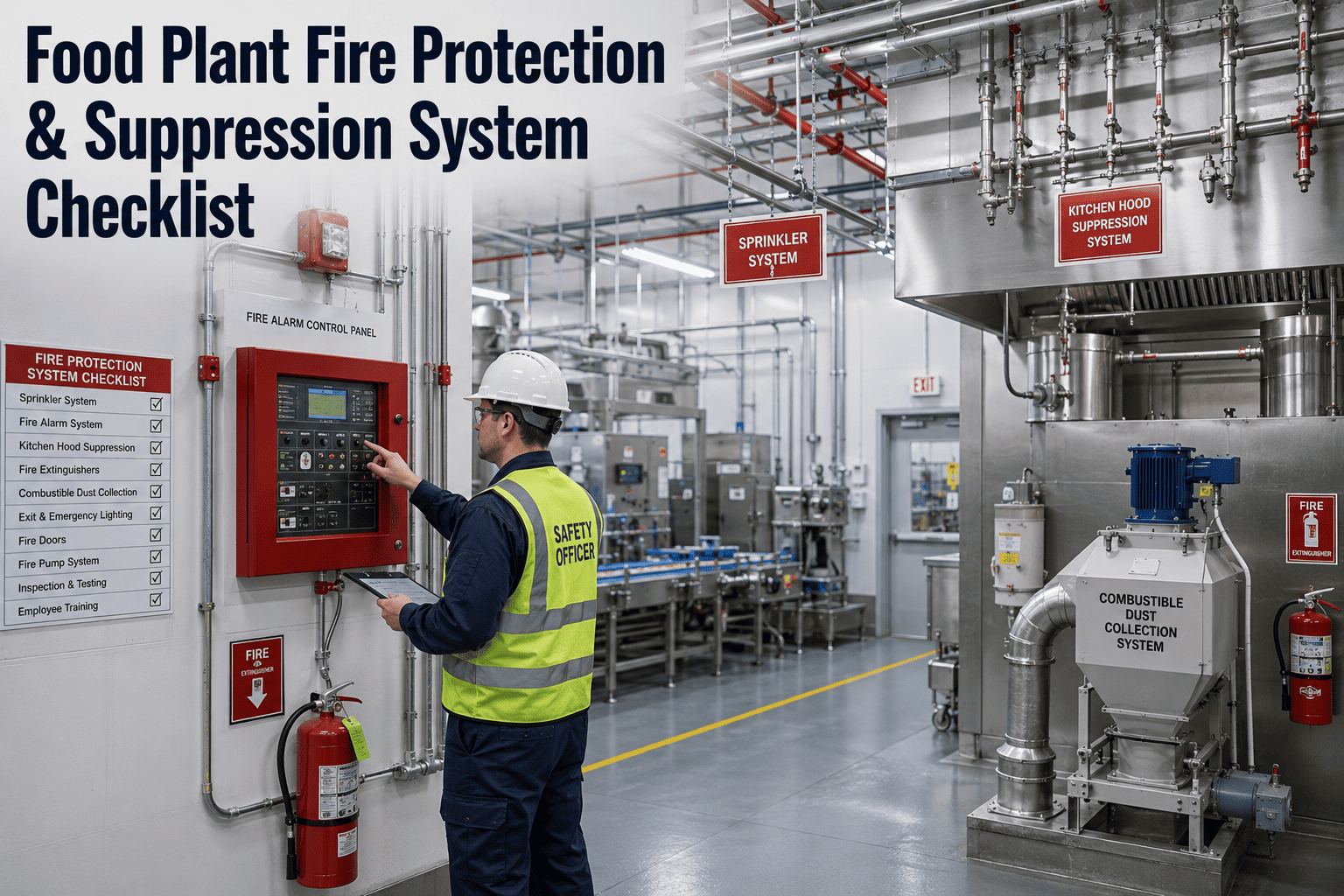
Flour, sugar, spice dust, and dried dairy products are all combustible at the particle sizes produced in food manufacturing. Ammonia refrigeration systems — standard in large food plants — create flammable and toxic atmosphere risk around compressor rooms and refrigeration headers. Hot work in these environments requires hazard assessment that goes beyond a basic welding permit.
What a Complete Hot Work Permit Must Address
A permit that simply authorises welding without evaluating the surrounding environment is inadequate. The permit must assess combustible dust accumulation in the work zone, proximity to flammable gas or vapour sources, fire suppression system status in the area, adjacent process equipment containing product or chemical, and fire watch duration after work completion.
In food plants processing products with National Fire Protection Association (NFPA) 654-relevant dusts, housekeeping in the hot work zone must be verified before ignition activity begins — not assumed.
Fire Watch Requirements
OSHA requires a fire watch during hot work and for at least 30 minutes after completion. In food environments with hidden combustible dust accumulation in wall cavities, insulation, and equipment enclosures, extended fire watch is standard practice. Fire watch personnel must have fire extinguisher training and a means to immediately alert the facility response team.
Fall Protection for Food Manufacturing Maintenance: Wet Surfaces and Elevated Access
The standard fall protection considerations — working at height above 4 feet, guardrails on platforms, covers on floor openings — apply in food plants, but with added complexity. Wet and slippery floors from washdown operations, condensation from refrigerated zones, and product spillage create slip-and-fall hazard at grade that precedes any elevated exposure.
Walking-Working Surface Management
29 CFR 1910.22 requires that all floors be maintained in a clean, dry condition and kept free from hazards. In food production environments where wet washdown is routine, this creates a housekeeping and drainage design challenge that maintenance teams must actively manage — not just acknowledge in a policy document.
Elevated Access to Tanks, Vessels, and Roof Equipment
Food plant maintenance technicians access tank tops for spray ball inspection, roof-mounted HVAC and refrigeration equipment, and mezzanine-level process platforms as standard job tasks. Each access point must have a defined fall protection method — permanent guardrail, personal fall arrest system, or safety net — with documented inspection records for all personal fall arrest equipment before each use.
Facilities in the UK and Canada operating under HSE and provincial OHS codes face requirements equivalent to OSHA's walking-working surface standards, with similar documentation expectations that a CMMS platform can systematise across jurisdictions.
OSHA Compliance Software and Platform Comparison for Food Manufacturing
| Compliance Capability | Paper-Based Systems | Generic EHS Software | Food-Focused CMMS (OxMaint) |
|---|---|---|---|
| LOTO Procedure Library | Binders at machines — version control gaps common | Document storage — not linked to work orders | Procedures linked to assets; version-controlled and accessible on mobile |
| Confined Space Permit Management | Paper permits — often incomplete or backdated | Generic permit templates — not food-configured | Digital permits with atmospheric test fields, rescue plan, and space inventory |
| Annual LOTO Audit Tracking | Spreadsheet — gaps found only at inspection | Calendar reminders — no procedure linkage | Automated audit scheduling with procedure linkage and technician sign-off |
| Hot Work Permit System | Paper forms — fire watch often undocumented | Generic permit workflow | Food-specific hot work permits with combustible dust assessment and fire watch timer |
| Training Record Integration | HR file — not accessible to EHS at point of assignment | Separate training module — manual cross-reference | Certification currency verified before authorised employee work order assignment |
| OSHA Inspection Audit Trail | Manual retrieval — days to compile during inspection | General record access — not mapped to OSHA standards | Instant audit-ready report by standard, asset, and date range |
| Mobile Access for Technicians | None — paper at point of work | Varies — rarely field-optimised | Full mobile permit, procedure, and work order access |
Common OSHA Compliance Failures in Food Manufacturing and How to Prevent Them
Generic LOTO Procedures Applied to Complex Machines
A single procedure saying "turn off power and apply lockout" does not meet OSHA's machine-specific requirement. Inspectors check whether procedures identify every energy source, every isolation point, and every verification step for each individual machine. Generic procedures are a citation waiting to happen — and a serious injury waiting to occur.
Confined Space Inventory That Does Not Match the Physical Plant
Facility modifications — new tanks, extended conveyors, added pits — frequently create new permit-required spaces that are not added to the written programme. An annual physical walkthrough comparing the space inventory against the actual plant must be formalised and documented.
Training Records That Cannot Be Produced During Inspection
OSHA inspectors will ask to see training records for the specific employees working on the day of an inspection. Records stored in HR systems inaccessible to EHS managers in the field — or records that show expired certification dates — result in citations even when the physical work was performed correctly. Centralised, accessible, and current training records are a non-negotiable compliance control. Book a Demo to see how OxMaint keeps training records audit-ready at all times.
Hot Work Permits Issued Without Combustible Dust Assessment
Food plants that have implemented hot work permit systems frequently use permits designed for metalworking environments — without fields for combustible dust evaluation. Inspectors are increasingly trained to recognise this gap, and OSHA's combustible dust national emphasis programme has elevated enforcement focus in flour, grain, sugar, and spice processing facilities.
Best Practices for OSHA Compliance Programme Excellence in Food Manufacturing
Integrate EHS and Maintenance in a Single Compliance Platform
When LOTO procedures, confined space permits, and hot work authorisations exist in EHS software that maintenance technicians cannot access in the field, compliance breaks at the moment of need. A unified platform where EHS requirements are embedded in the work order — not stored separately — creates the integration that makes compliance consistent rather than aspirational.
Use Inspection Data to Prioritise Training Investment
OSHA inspection citations, near-miss records, and work order anomaly data tell EHS managers exactly where the programme is failing. Using this data to direct training — rather than running the same annual refresher for everyone regardless of observed gaps — produces measurable improvement in compliance rates and incident reduction.
Verify Contractor OSHA Compliance Before Entry
Contractors performing maintenance in food plants are subject to the host employer's OSHA obligations under multi-employer worksite rules. Establishing a contractor compliance verification process — reviewing LOTO capability, confined space training, and hot work certification before contractors are permitted on site — protects both the food plant and the contractor workforce. Book a Demo to see how OxMaint manages contractor qualification records alongside internal maintenance compliance.
Build Audit Readiness Into Daily Operations
The difference between a food plant that passes an OSHA inspection with no citations and one that receives a repeat violation notice is rarely the quality of their written programme — it is whether their daily operations generate documentation that reflects the programme's requirements. A CMMS that captures permit completion, LOTO audit sign-off, training currency, and inspection findings in searchable, dated records is the infrastructure that makes daily compliance visible and audit readiness automatic.
Build an Audit-Ready OSHA Compliance Programme
OxMaint gives food manufacturing EHS and maintenance teams one platform to manage LOTO procedures, confined space permits, hot work authorisations, and training records — with audit-ready documentation for US, UK, Canada, Germany, and UAE facilities.
Frequently Asked Questions: OSHA Compliance for Food Manufacturing Maintenance
What OSHA standards apply most frequently to food manufacturing maintenance teams?
The most cited OSHA standards in food manufacturing are 29 CFR 1910.147 (lockout/tagout), 29 CFR 1910.146 (permit-required confined spaces), 29 CFR 1910.212 (machine guarding), 29 CFR 1910.252 (hot work), and 29 CFR 1910.28 (fall protection). OSHA inspection data consistently ranks LOTO as the top citation in food and beverage facilities.
How often must lockout/tagout procedures be audited under OSHA requirements?
29 CFR 1910.147(c)(6) requires annual certification that LOTO procedures are adequate and that employees follow them. The audit must be performed by an authorised employee other than the one who uses the procedure. The certification must be documented — including the machine or equipment audited, the date of the audit, and the employees included in the audit.
What makes a confined space permit-required in a food manufacturing facility?
A confined space is permit-required if it contains or has the potential to contain a serious hazard — including a hazardous atmosphere, material that could engulf an entrant, an internal configuration that could trap a person, or any other recognised serious safety or health hazard. In food plants, tanks, silos, enclosed pits, tunnels, and large vessels frequently qualify — often more than facilities initially identify.
Is a hot work permit required for all welding and grinding in food plants?
OSHA 29 CFR 1910.252 requires that before any welding, cutting, or burning is performed, the area must be examined for fire hazards and a hot work authorisation issued when hazards are present. In food facilities with combustible dust from flour, sugar, spice, or dried dairy products, a hazard assessment is required before every hot work event — and the permit system should include explicit combustible dust evaluation fields.
How can a CMMS improve OSHA compliance in food manufacturing?
A CMMS integrates LOTO procedures into work orders, manages digital confined space and hot work permits, tracks training currency for every authorised employee, schedules annual programme audits automatically, and generates audit-ready compliance records instantly. Plants using CMMS-managed compliance programmes consistently report fewer repeat OSHA citations and faster response during unannounced inspections.
Do OSHA machine guarding requirements apply when equipment is shut down for cleaning in food plants?
When equipment is shut down for cleaning or maintenance and workers are exposed to hazardous energy, LOTO requirements under 29 CFR 1910.147 apply — not machine guarding alone. Machine guarding under 29 CFR 1910.212 applies when the machine is running. The critical compliance requirement is that guards removed for access during LOTO work must be reinstalled — and verified reinstalled — before the machine is returned to operation.